
October 13, 2026
Pressure Gauge Selection: Range, Accuracy Class and Connection
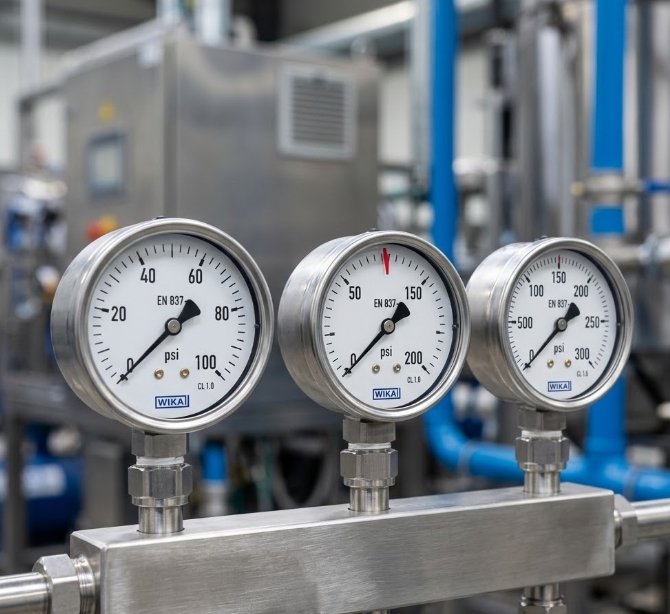
Most pressure gauge failures are specification failures, not manufacturing ones. A gauge fitted on the wrong range, with the wrong connection or no protection against pulsation, will read badly within months. Four decisions settle it: range, accuracy class, connection, and whether the process needs isolating from the movement.
Range: use the middle of the dial
The working pressure should sit around the middle of the scale, and the normal maximum should not exceed roughly three-quarters of full scale. A gauge run near the top of its range fatigues the bourdon tube and drifts; a gauge run in the bottom tenth cannot be read accurately. If your line runs at 6 bar, a 0–10 bar gauge is right and a 0–40 bar gauge is a wasted instrument.
Accuracy class
Accuracy is quoted as a percentage of full scale, so it is absolute, not proportional. A 1.0 class gauge on a 0–40 bar dial is ±0.4 bar everywhere on the scale — which is why an oversized range costs you accuracy twice over. General plant service is usually well served by standard commercial classes; test, calibration and custody duties need a tighter class and a certificate.
Connection and mounting
- Thread form and size — confirm the actual fitting rather than assuming the previous gauge was correct.
- Entry — bottom entry for direct line mounting, back entry for panel mounting.
- Dial size — drive this from reading distance, not from the space available.
Protecting the gauge
This is the step most often skipped. Pulsation from reciprocating pumps destroys a movement quickly — a snubber or a liquid-filled case damps it. Spikes need an over-pressure protector. Hot media need a siphon so the gauge sees condensate rather than live steam. Aggressive or solids-laden fluids need a diaphragm seal so the process never reaches the bourdon tube at all. Fitting a bare gauge into any of those services is a short-term decision.
What to tell us
Working and maximum pressure, the medium, the operating temperature, the connection thread, dial size and whether the gauge is line or panel mounted. If the service is pulsating, hot or dirty, say so — that changes the specification more than any other single factor. We supply WIKA pressure gauges alongside economy ranges and temperature gauges, and we will tell you when the cheaper instrument is genuinely sufficient.
Indicative guidance only. Accuracy classes, ranges and connection standards vary by manufacturer and model; confirm against the datasheet for the gauge we quote before specifying from it.