
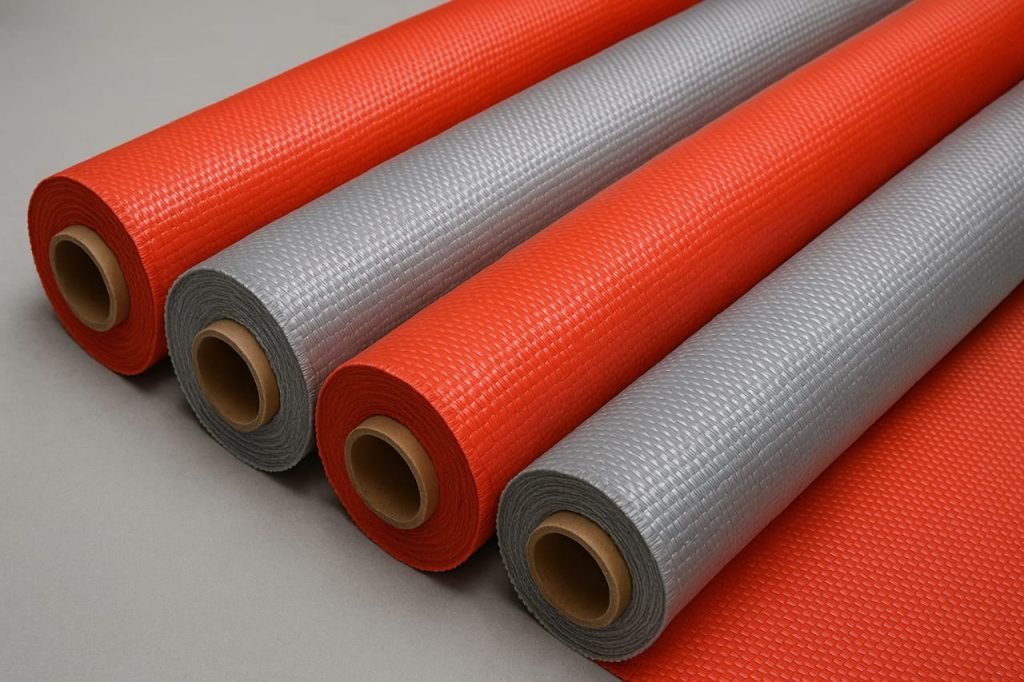
Silicone Coated Fiberglass Fabric
Silicone coated fiberglass fabric has quite similar characteristics to those of PTFE coated fiberglass fabric but they are more flexible,Very non-stick,More tear resistant and have non slip surface.These fabrics are available coated on one side in red,Gray,Black etc colour available in 0.5mm to 3mm thickness.Due to its superior abrasion resistance and excellent dielectric and release properties Silicone coated fiberglass fabric finds its extensive application in the manufacturing of non-metallic bellows,Expansion joint and industrial silicone curtain.
- More flexible & tear-resistant than PTFE-coated fabric
- Very non-stick, non-slip surface with excellent abrasion resistance
- Good dielectric & release properties
- For bellows, expansion joints & industrial silicone curtains
Overview
Silicone coated fiberglass fabric is a woven glass-fibre cloth coated on one side with silicone rubber. It shares the heat resistance and strength of the glass base with a tough, flexible, non-stick silicone surface — and it occupies a useful middle ground next to PTFE-coated fiberglass fabric. It has broadly similar characteristics, but is noticeably more flexible, more tear-resistant and less slippery, which makes it easier to fabricate and better suited to parts that flex in service.
That flexibility and tear resistance is why it is the fabric of choice for dynamic components. Non-metallic bellows and fabric expansion joints have to flex through thousands of thermal cycles without cracking or splitting, and the silicone-coated cloth takes that repeated movement far better than a stiffer coated fabric would. Its non-slip surface also makes it easier to handle and fit than the very low-friction PTFE grade.
On performance it brings superior abrasion resistance and good dielectric and release properties, so it is used both as a mechanical barrier and as an electrical insulator, and as a release surface where hot or sticky material must not adhere. It is supplied coated on one side in a range of colours — typically red, grey or black — in thicknesses from about 0.5 mm to 3 mm.
Choose silicone-coated when you need flexibility, toughness and easy handling; choose the PTFE-coated grade when you need the ultimate in chemical resistance and the lowest-friction, most heat-tolerant non-stick surface. Tell us the application (bellows, expansion joint, curtain, insulation) and the thickness and colour you need.
Specifications
Typical properties of one-side silicone-coated glass fabric. Exact temperature and thickness vary by grade.
| Property | Value | Test Standard |
|---|---|---|
| Base Fabric | Woven fiberglass (glass fibre) | — |
| Coating | Silicone rubber, one side | — |
| Flexibility | High — suits flexing / cycling parts | — |
| Tear Resistance | High (better than PTFE-coated) | — |
| Surface | Non-stick, non-slip | — |
| Abrasion Resistance | Superior | — |
| Electrical | Good dielectric / insulating | — |
| Thickness | 0.5 mm – 3 mm | — |
| Colours | Red, grey, black | Typical |
| Release Properties | Good — hot/sticky material will not adhere | — |
Applications
Where a heat-resistant fabric has to flex, resist tearing and stay non-stick.
Downloads
Frequently Asked Questions
Silicone-coated or PTFE-coated fiberglass — which do I need?
They are close cousins. Choose silicone-coated when you need flexibility, tear resistance and easy handling — bellows, expansion joints, curtains. Choose PTFE-coated when you need the highest chemical resistance and the most heat-tolerant, lowest-friction non-stick surface.
How flexible is it?
More flexible than PTFE-coated fabric, which is its main advantage. That flexibility is why it survives the repeated flexing in bellows and expansion joints without cracking.
Is it coated on one side or both?
Standard supply is coated on one side. Tell us the application and we will confirm the right construction, thickness and colour.
What thicknesses and colours are available?
Thicknesses from about 0.5 mm to 3 mm, typically in red, grey or black. The thickness is chosen from the mechanical duty and the temperature/abrasion exposure.
Can it be used for electrical insulation?
Yes — it has good dielectric properties, so it works as an electrical insulating barrier as well as a mechanical and heat barrier.
Is the surface really non-stick?
Yes — silicone gives a genuinely non-stick, non-slip release surface, so hot or sticky material will not adhere. It is less slippery than PTFE, which actually makes it easier to handle and fit.
Need a quote or a spec check?
Send us your operating conditions and we will confirm the right grade for the job.
Not sure this is the right material?
Launch the Solution Finder