
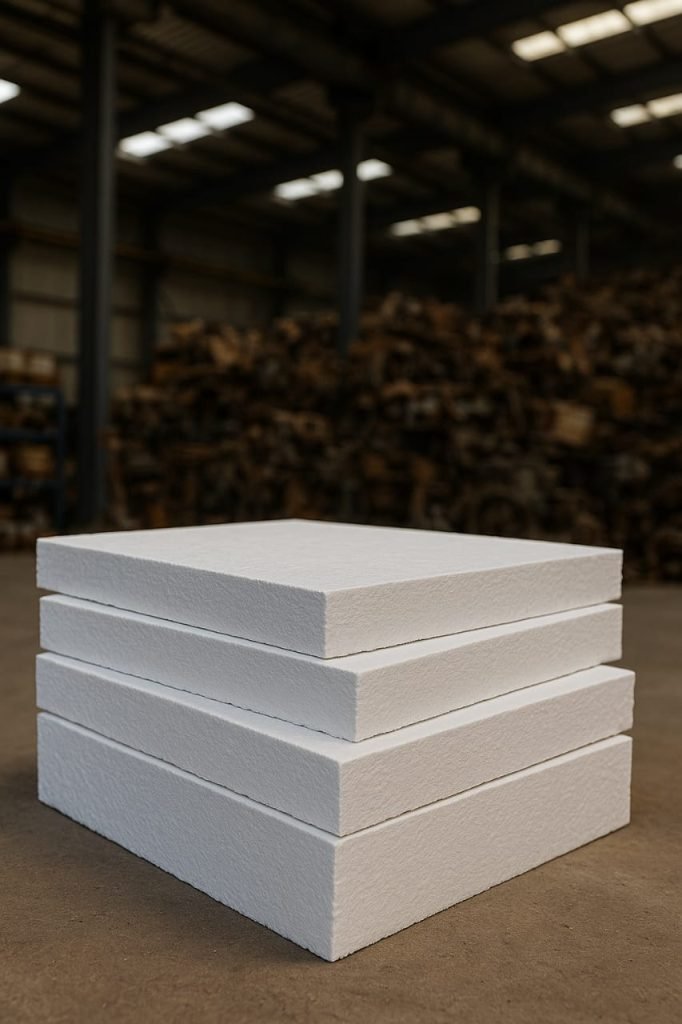
Ceramic Board
Ceramic fiber boards are manufactured in a wet vacuum forming process by blending the chopped ceramic fiber with inorganic or organic binders for excellent abrasive resistance at high temperature.Ceramic fiber board feature low thermal conductivity,High thermal stability and excellent thermal shock resistance.Applications of ceramic fiber board include hot air duct lining,Shuttle kiln with high gas velocity,Laboratory furnace and die-cut high temperature seal.
- Rigid ceramic fibre board — self-supporting high-temperature insulation
- Low thermal conductivity with high thermal stability
- Resists gas erosion & abrasion where blanket would not
- For furnace & kiln linings, hot-air ducts and hot seals
Overview
Ceramic board is the rigid form of ceramic fibre insulation. It is manufactured by vacuum-forming — blending chopped ceramic fibre with inorganic or organic binders and drawing it into a solid, self-supporting board. That rigidity is the whole point: where flexible ceramic fibre wool (blanket) drapes and packs into place, ceramic board stands on its own as a structural hot-face lining that keeps its shape and resists mechanical and gas erosion.
It combines the low thermal conductivity you expect from ceramic fibre — so it insulates efficiently in a thin section — with high thermal stability and excellent thermal-shock resistance, meaning it takes rapid heat-up and cool-down cycles without cracking or slumping. Crucially, the vacuum-formed structure also gives it good abrasive resistance at high temperature, so it holds up against high-velocity hot gas that would erode a soft blanket.
That mix of properties defines where it is used. It lines hot-air ducts and furnace hot faces; it is specified in shuttle kilns and other equipment with high gas velocity, where its erosion resistance matters; it forms the working lining of laboratory and industrial furnaces; and it is die-cut into rigid high-temperature seals, gaskets and spacers where a soft material would crush.
It is supplied in a range of thicknesses and densities. As a rule, use board where the lining must be self-supporting, erosion-resistant or machinable, and use blanket where you need a flexible wrap that packs around shapes. Tell us the temperature, the gas conditions and the form you need and we will recommend the grade.
Specifications
Typical properties of vacuum-formed ceramic fibre board. Temperature grade and density vary — confirm against the furnace duty.
| Property | Value | Test Standard |
|---|---|---|
| Material | Vacuum-formed ceramic fibre + binder | Rigid board |
| Form | Rigid, self-supporting board | vs. flexible blanket |
| Thermal Conductivity | Low — efficient insulation | — |
| Thermal Stability | High | — |
| Thermal-Shock Resistance | Excellent | — |
| Abrasion / Gas Erosion | Good — resists high-velocity hot gas | — |
| Machinability | Can be cut & die-cut to shape | — |
| Thicknesses / Densities | Range to suit duty | To order |
| When to use blanket instead | Flexible wrapping around shapes | Cross-link |
Applications
The rigid ceramic fibre lining for hot faces that have to hold their shape and resist erosion.
Downloads
Frequently Asked Questions
Ceramic board or ceramic fibre blanket — which do I need?
Use board where the lining must be rigid and self-supporting, resist high-velocity gas erosion, or be machined to shape. Use blanket (wool) where you need a flexible wrap that packs around shapes. Same fibre, two forms for two jobs.
Why is it better than blanket for high gas velocity?
The vacuum-formed structure gives the board abrasion and gas-erosion resistance that a soft blanket does not have. In shuttle kilns and high-velocity hot-gas zones, blanket erodes; board holds up.
Can it be cut and machined?
Yes — it can be cut and die-cut to shape, which is why it is used for rigid high-temperature seals, gaskets and spacers as well as furnace linings.
Does it resist thermal shock?
Yes — it has excellent thermal-shock resistance, so it takes rapid heat-up and cool-down cycles (as in shuttle kilns and batch furnaces) without cracking or slumping.
What thickness do I need?
Thickness follows the hot-face temperature and the cold-face target — more thickness for a higher temperature drop. Tell us the operating temperature and the gas conditions and we will recommend thickness and density.
What temperature can it take?
Ceramic fibre board is a high-temperature furnace material; the exact rating depends on the grade. Tell us your peak operating temperature and we will match the correct temperature-grade board.
Need a quote or a spec check?
Send us your operating conditions and we will confirm the right grade for the job.
Not sure this is the right material?
Launch the Solution Finder