
July 8, 2026
PTFE Rod vs POM (Delrin) vs Nylon Rod: Choosing the Right Engineering Plastic
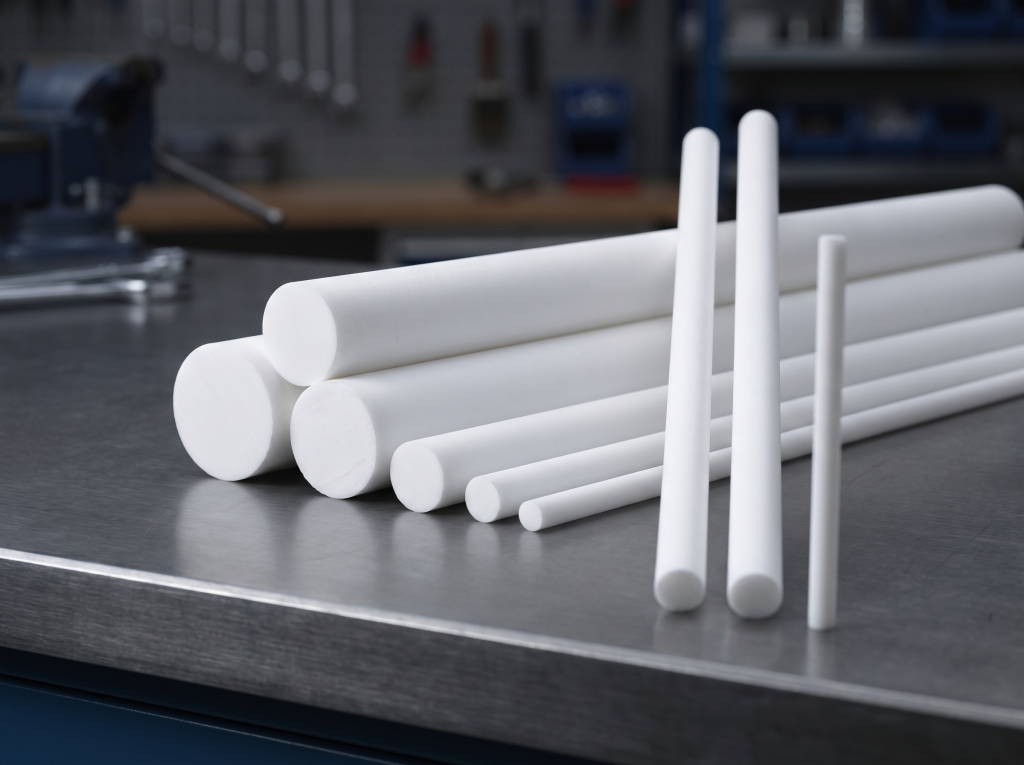
PTFE, POM (Delrin) and Nylon rod all get specified for similar-looking jobs — bushes, bearings, spacers, wear pads — and choosing between them by habit rather than by the actual duty is a common, costly mistake. Each material wins clearly on a different property.
Temperature range: PTFE wins decisively
PTFE Rods operate from about -180°C to +260°C. POM and Nylon are both limited to roughly 100–120°C continuous — well over 100°C lower than PTFE’s ceiling. If the application runs hot, or needs to survive cryogenic cold, PTFE is the only one of the three that qualifies.
Friction and non-stick surface: PTFE again
PTFE has the lowest coefficient of friction of the three (roughly 0.04–0.10), which is why it dominates non-stick, low-friction sliding applications. POM and Nylon have broadly similar friction to each other — both usably low, but nowhere near PTFE’s.
Mechanical strength and stiffness: POM (Delrin) wins
POM is significantly stronger and stiffer than PTFE, and generally shows better wear resistance under load thanks to its higher mechanical strength and dimensional stability. For precision-machined gears, bushings, sliders and guide rails where load-bearing rigidity matters more than absolute friction or heat range, POM is usually the better choice.
Where Nylon fits
Nylon is broadly similar to POM in temperature range and friction, with generally better dry abrasion resistance in some conditions, but it absorbs moisture — which changes its dimensions and properties over time in humid or wet environments. POM is more dimensionally stable where moisture exposure is a factor.
Chemical resistance: PTFE, again, by a wide margin
PTFE is close to chemically inert across the full pH range. Neither POM nor Nylon comes close — both can be attacked by various solvents and strong acids/alkalis that PTFE simply ignores.
A quick decision table
| Priority | Best choice |
|---|---|
| Temperature range (hot or cryogenic) | PTFE Rods |
| Chemical resistance | PTFE Rods |
| Non-stick / lowest friction | PTFE Rods |
| Mechanical strength / stiffness / precision gears | POM (Delrin) |
| Dry abrasion resistance, humid-environment caution | Nylon (watch moisture) |
Frequently asked questions
Is PTFE always the “best” choice since it wins on so many properties? No — where mechanical load and precision matter more than heat or chemical resistance, POM’s strength and stiffness make it the better engineering choice, often at lower cost too.
Does Nylon’s moisture absorption make it unsuitable for most industrial use? Not unsuitable, but worth accounting for — in humid or wet environments, expect some dimensional change over time that POM would resist better.
Can PTFE Rod be used for structural, load-bearing parts? It’s better suited to seals, low-friction bearings and chemical-resistant components than heavily loaded structural parts, where POM’s higher stiffness performs better.
Tell us your temperature range, load, and chemical exposure and we’ll confirm whether PTFE is the right material for your application, or point you toward a better-suited alternative.