
July 8, 2026
Graphite vs Carbon Fiber vs Aramid Gland Packing: A Full Comparison
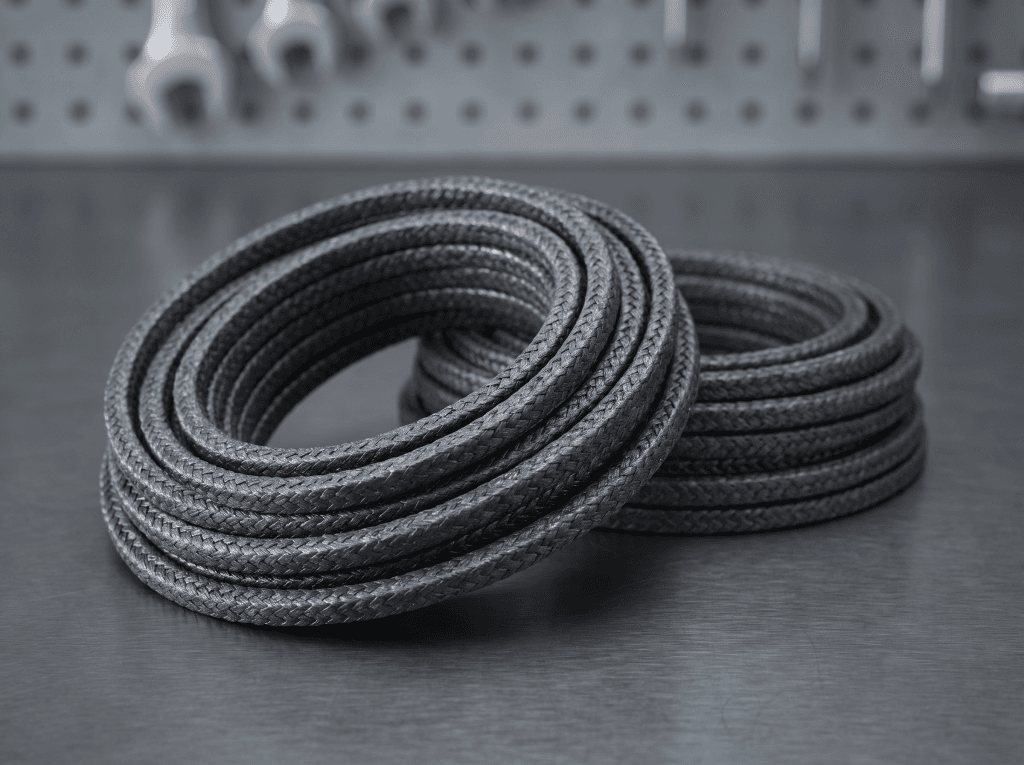
Beyond the basic PTFE-versus-graphite decision, three specialised gland packing bases each solve a specific problem that the others don’t: graphite for raw heat, carbon fibre for high-speed rotating equipment, and aramid for abrasive slurry. Knowing which problem you actually have makes the choice straightforward.
Graphite: maximum heat and self-lubrication
Graphite Gland Packing is rated to 450°C on rotating equipment and up to roughly 650°C on valves, with excellent self-lubrication and thermal conductivity. It’s the correct default for steam, boiler-feed and general high-temperature service across the full pH range.
Carbon fibre: the highest temperature ceiling, with less shaft heat transfer
Carbon Fiber Packing pushes higher still — around 600°C — while conducting less heat into the bearing than graphite does, which matters on equipment where bearing temperature is a concern. It also handles higher shaft speeds (up to about 20 m/s) with good wear characteristics.
Aramid: built for abrasion, not heat
Aramid Gland Packing has a much lower temperature ceiling (around 260°C) but resists abrasion and extrusion far better than either graphite or carbon fibre — this is the packing for slurry, pulp and mineral-processing duty, not for high heat.
Combining materials: a common real-world solution
These three are often combined rather than used alone — aramid end rings around a graphite or carbon-fibre core give both abrasion resistance at the ends (where extrusion risk is highest) and the core material’s heat or lubrication properties in the body of the seal.
A quick decision table
| Primary problem | Best choice |
|---|---|
| High heat, steam, boiler service | Graphite Gland Packing |
| Very high heat + high shaft speed, bearing-sensitive | Carbon Fiber Packing |
| Abrasive slurry, low-to-moderate heat | Aramid Gland Packing |
| Abrasive slurry AND high heat | Aramid end rings + graphite core |
Frequently asked questions
Which of the three is most cost-effective for general use? Graphite, generally — it covers the widest range of standard applications at a moderate cost, with carbon fibre and aramid reserved for their specific specialised problems.
Can carbon fibre packing replace graphite in all high-temperature applications? It can go hotter, but where bearing heat transfer isn’t a concern, graphite’s better self-lubrication often makes it the more practical everyday choice.
Tell us whether your problem is heat, shaft speed or abrasion and we’ll confirm the right packing — or combination — for your equipment.