
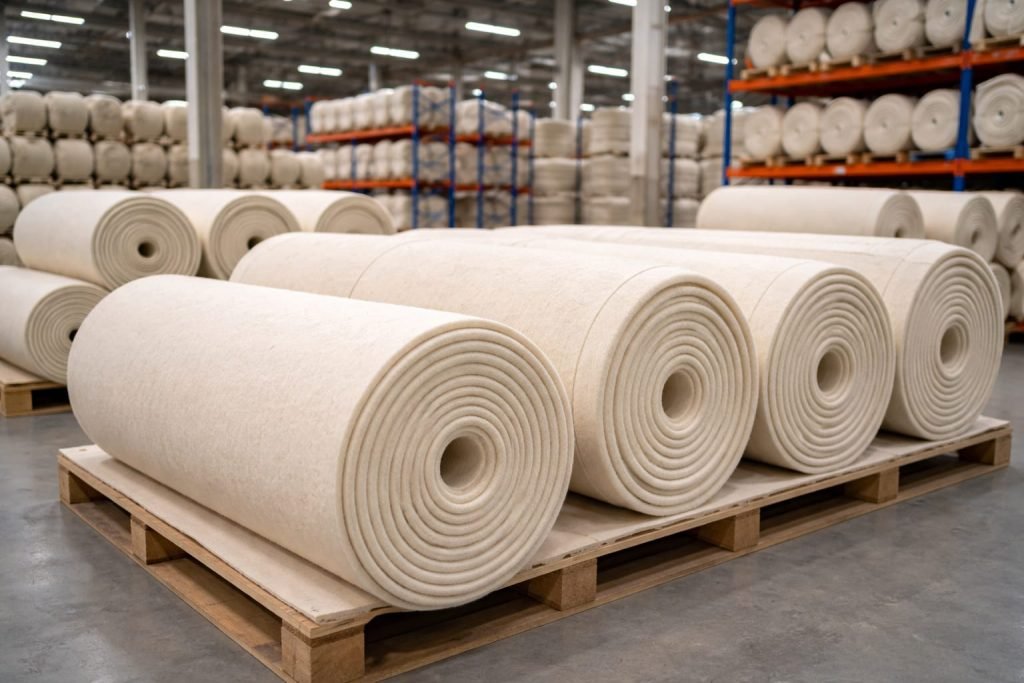
Wool Felt
Wool felt is used in a wide range of industries and manufacturing processeses from the automotive industries to home construction.It is also used as a damper in musical instruments.This type of felt is frequently used in industry as a sound or vibration damper and in machinery for cushioning and padding moving parts.Wool felts also find their extensive application as a base in heat press such as leather press or printing press etc.The hardness and high density of wool felt enable it to be used in steel polishing and marble polishing.It is also used for oil absorption,Anti vibration,Shock absorber,Making gaskets and oil seals and also for packing purposes.It is available in different widhts and thickness depending on customer requirement.
- High density & hardness — the premium mechanical felt
- Damps vibration & sound; cushions moving parts
- Used to polish steel & marble to a fine finish
- Absorbs oil — for oil seals, wicks & gaskets
Overview
Wool felt is the dense, hard-wearing natural felt used where a synthetic felt simply is not tough or dense enough. Made by matting natural wool fibres under heat, moisture and pressure, it comes out as a solid, resilient material with a combination of density, hardness and elasticity that no bonded synthetic felt quite matches. That is why, across industries from automotive to home construction, wool felt is specified for the demanding mechanical jobs.
Its density and controlled hardness are what let it polish. Wool felt wheels and pads are used to bring steel and marble to a fine finish — the firm, uniform surface carries polishing compound and works the material evenly without gouging. The same density makes it an excellent vibration and sound damper and a cushion for moving machine parts, which is why it appears everywhere from spinning machinery to the dampers inside musical instruments.
It is also naturally absorbent, and that absorbency is put to work: wool felt is used for oil absorption, as oil-seal and wick material, and as packing that holds lubricant against a moving shaft. Its resilience makes it a shock absorber and anti-vibration pad, and its heat tolerance makes it the base pad in heat presses such as leather and printing presses. It is cut into gaskets and seals where a firm, resilient, oil-holding material is needed.
It is supplied in a range of densities and thicknesses — harder, denser grades for polishing and seals, softer grades for cushioning and sound damping. Where cost is the priority and you do not need this density, our polyester felt is the economical alternative. Tell us the application and we will recommend the grade.
Specifications
Typical properties of natural wool felt. Density (hardness) and thickness are chosen from the mechanical duty.
| Property | Value | Test Standard |
|---|---|---|
| Material | Natural wool fibre, pressed felt | — |
| Density / Hardness | High — the defining property | Grades vary |
| Resilience | High — recovers after compression | — |
| Absorbency | Naturally absorbent — holds oil | — |
| Damping | Excellent vibration & sound damping | — |
| Key Uses | Polishing, seals, damping, cushioning | — |
| Thicknesses / Densities | Range to suit duty | To order |
| Widths | Range of widths | — |
| Economical Alternative | Polyester felt (where density not critical) | — |
Applications
The dense, resilient felt for polishing, sealing, damping and cushioning.
Downloads
Frequently Asked Questions
Wool felt or polyester felt — what is the difference?
Wool is the dense, hard, resilient natural felt for demanding mechanical jobs — polishing, oil seals, heavy damping. Polyester is the economical synthetic for padding and filtration. If you need density and hardness, use wool; if you need low cost, use polyester.
Why is wool felt used for polishing?
Its high density and controlled hardness give a firm, uniform surface that carries polishing compound and works steel or marble evenly without gouging. A soft or loose felt cannot hold the compound or the pressure the same way.
Is it good for oil seals?
Yes — wool felt is naturally absorbent and resilient, so it holds oil against a moving shaft and springs back to keep contact. That is exactly why it is a traditional oil-seal, wick and packing material.
Does it really damp vibration and sound?
Yes — its density and resilience make it an excellent vibration and sound damper, which is why it is used both in machinery and as the dampers inside musical instruments.
What density (hardness) do I need?
Harder, denser grades for polishing, seals and gaskets; softer grades for cushioning and sound damping. Tell us the application and we will recommend the density, thickness and width.
Can it take heat?
It tolerates the moderate heat of applications like heat-press base pads, but it is not a high-temperature or flame product — for that use a glass or ceramic fibre material.
Need a quote or a spec check?
Send us your operating conditions and we will confirm the right grade for the job.
Not sure this is the right material?
Launch the Solution Finder