
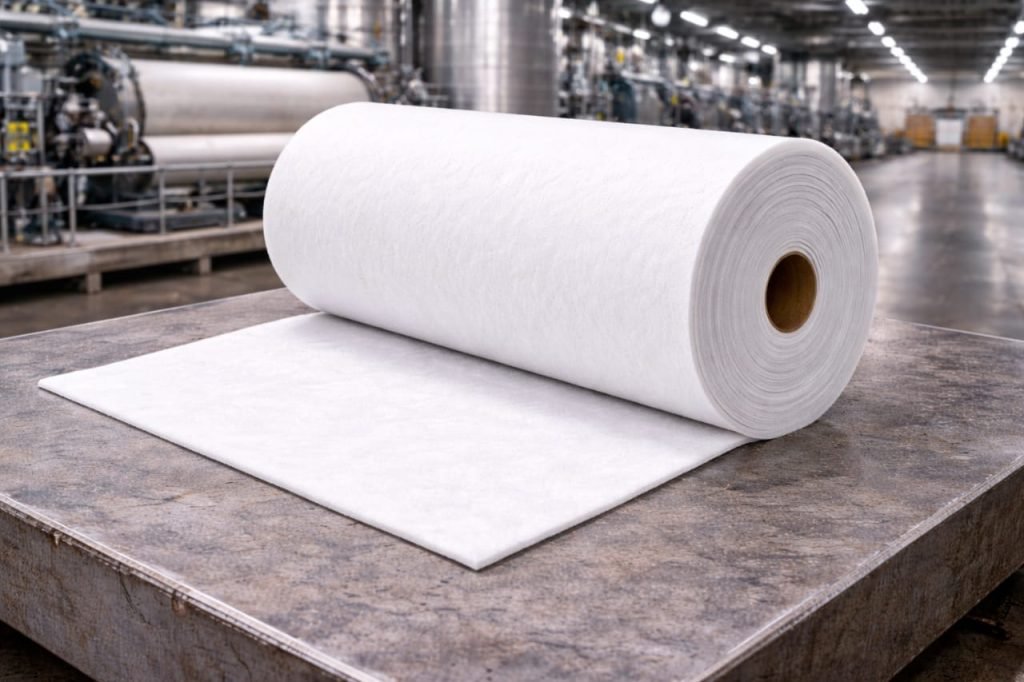
Polyester Felt
Polyester felt has a wide range of industrial applications including furniture padding,Air and liquid filtration,Fluid retention,Pen tips,Structural boards,Clothing and crafts.Polyester felts are less expensive as compared to other type of felts.They have good resistance to most mineral and organic acids and have excellent resistance to ageing.The advantage of polyester felt is that they are superior in dry heat applications and have excellent resistance to bleaches and other oxidizing agents.These are available in different widhts and sizes depending on customer requirement.
- Economical synthetic felt — the cost-effective choice
- Excellent resistance to ageing, bleaches & oxidising agents
- Good resistance to most mineral & organic acids
- Superior in dry-heat applications & filtration
Overview
Polyester felt is a synthetic non-woven felt made by bonding polyester fibres into a uniform, resilient mat. It is the practical, economical workhorse of the felt family: it costs less than natural and specialty felts while covering a very wide range of padding, filtration and general industrial uses. Where you do not specifically need the density of wool felt, polyester felt usually does the job for less.
Its chemistry is where it earns its place. Polyester has excellent resistance to ageing, so it does not perish or embrittle quickly in service, and it stands up well to bleaches and other oxidising agents that attack natural fibres. It also resists most mineral and organic acids. That durability, combined with its performance in dry heat, makes it reliable in filtration and process environments that would degrade a less stable felt.
The range of uses reflects that versatility: furniture and upholstery padding, air and liquid filtration media, fluid retention and wicking, pen and marker tips, structural and backing boards, and clothing and craft applications. In industry it is most valued as an economical filtration and padding medium.
It is supplied in a range of thicknesses, densities and widths to suit the duty — thin, dense grades for filtration and wicking, thicker grades for padding and cushioning. For applications that demand maximum density and hardness — polishing, heavy vibration damping, oil seals — see our wool felt instead. Tell us the application and we will recommend the grade.
Specifications
Typical properties of non-woven polyester felt. Density and thickness are selected from the padding or filtration duty.
| Property | Value | Test Standard |
|---|---|---|
| Material | Non-woven bonded polyester fibre | Synthetic |
| Cost | Economical — lower than wool/specialty felt | — |
| Ageing Resistance | Excellent | — |
| Bleach / Oxidiser Resistance | Excellent | — |
| Acid Resistance | Good to most mineral & organic acids | — |
| Dry-Heat Performance | Superior | — |
| Primary Uses | Filtration, padding, fluid retention | — |
| Thicknesses / Densities | Range to suit duty | To order |
| Widths | Range of roll widths | — |
Applications
The economical felt for filtration, padding and general industrial use.
Downloads
Frequently Asked Questions
Polyester felt or wool felt — which should I choose?
Choose polyester for economy, chemical/ageing resistance and filtration — it does most padding and filtration jobs for less. Choose wool felt when you specifically need maximum density and hardness — polishing, heavy vibration damping, oil seals.
Is it resistant to chemicals?
It resists most mineral and organic acids, and it is excellent against bleaches and other oxidising agents that attack natural fibres. That chemical stability, plus its ageing resistance, is a big part of why it is used in filtration.
Can it handle heat?
It performs well in dry-heat applications. For high-temperature or flame exposure, though, a glass or ceramic fibre product is the correct choice, not a polyester felt.
Why is it cheaper than other felts?
Because it is a synthetic fibre produced in volume, polyester felt costs less than natural wool and specialty felts — while still covering the majority of padding and filtration duties. It is the cost-effective default.
What thickness and density do I need?
Thin, denser grades suit filtration and wicking; thicker, softer grades suit padding and cushioning. Tell us the application and we will recommend the thickness, density and width.
Is it absorbent?
Yes — it has controlled absorbency, which is why it is used for fluid retention and wicking as well as filtration. The grade sets how much it holds.
Need a quote or a spec check?
Send us your operating conditions and we will confirm the right grade for the job.
Not sure this is the right material?
Launch the Solution Finder