
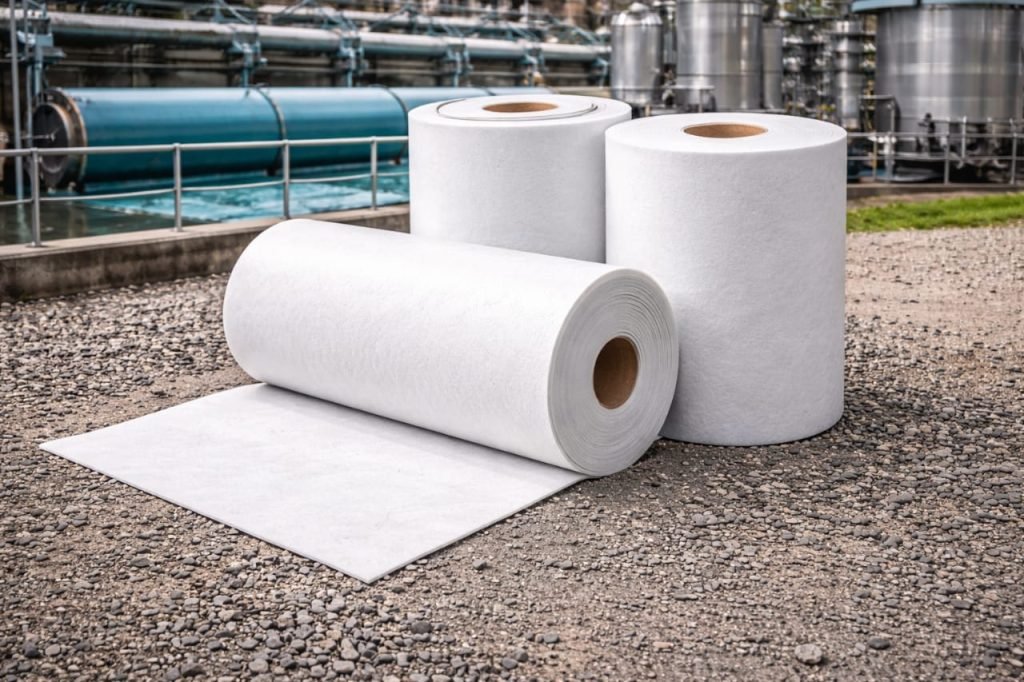
Non Woven Geo Textile Felts
Non woven geotextiles are manufactured by bonding materials together either through chemical or heat,Needle punching or other methods.Non woven geotextiles have a wide range of applications in civil environmental engineering and construction projects.Their most common uses include filtration of soils in drainage applications,Seperation and stabilization in road and railway construction,Prevention of soil movement in erosion control measures.It is also suitable for cushioning and protection in many containment projects.Non woven geotextiles are Uv resistant and are stable within 2-13 Ph range.
- Filters, separates, drains & protects — four jobs in one fabric
- Needle-punched non-woven — high permeability with soil retention
- UV resistant & chemically stable across pH 2–13
- For roads, railways, drainage, erosion control & containment
Overview
Non-woven geotextile is an engineering fabric that does the unglamorous but critical jobs beneath roads, embankments, drains and landfills. It is manufactured by bonding fibres together — most commonly by needle-punching, which mechanically entangles the fibres into a strong, permeable felt, sometimes reinforced by thermal or chemical bonding. The result is a fabric that lets water pass through freely while holding soil particles back.
That combination of permeability and soil retention is what makes it so useful. In a drainage application it filters fine soil out of the water so the drain does not silt up. Between two dissimilar layers — say a stone sub-base over soft subgrade — it acts as a separator, stopping the aggregate from punching down into the soil and the soil from pumping up into the aggregate, which is what preserves the load-bearing structure of a road or railway over years of traffic.
It also stabilises and protects. Laid over weak ground it spreads load and reinforces the subgrade; on slopes and channels it holds soil in place against erosion; and in containment works — landfill caps, pond and reservoir liners — it cushions and protects the waterproofing membrane from puncture by sharp stones. Because the fabric is UV resistant and chemically stable across a pH range of roughly 2 to 13, it survives long-term burial and exposure without degrading.
We supply non-woven geotextile in a range of weights and widths to suit the duty — lighter grades for separation and filtration, heavier grades for reinforcement and membrane protection. Tell us the application (drainage, separation, erosion control or containment) and the ground conditions and we will recommend the right grade.
Specifications
Typical properties of needle-punched non-woven geotextile. Weight, strength and permeability vary by grade — select the grade to match the engineering duty.
| Property | Value | Test Standard |
|---|---|---|
| Type | Non-woven, needle-punched (bonded felt) | — |
| Primary Functions | Filtration, separation, drainage, protection | — |
| Permeability | High — passes water, retains soil | — |
| UV Resistance | UV stabilised | — |
| Chemical Stability | Stable across pH 2 – 13 | — |
| Grades | Light (filtration/separation) to heavy (protection) | By weight (gsm) |
| Widths | Range of roll widths | To order |
| Supply | Rolls, cut to project requirement | — |
Applications
The fabric that keeps civil earthworks and containment structures performing over their design life.
Downloads
Frequently Asked Questions
What does a non-woven geotextile actually do?
Four jobs, often at once: it filters (passes water, holds soil back), separates two soil/aggregate layers so they do not mix, drains water within its plane, and protects membranes from puncture. Which job dominates depends on where you place it.
Woven or non-woven — which do I need?
For filtration, drainage and membrane protection, non-woven is the right choice — it is permeable and cushioning. Woven geotextiles are used more where high tensile reinforcement strength is the priority. For most drainage and separation work, non-woven is what is specified.
Will it clog up over time?
A correctly graded non-woven is designed not to. Its pore structure lets water through while retaining the surrounding soil, so it filters rather than blinds. Choosing the right grade for the soil is what prevents both clogging and soil piping.
Is it resistant to chemicals in the ground?
Yes — it is chemically stable across roughly pH 2 to 13, so it withstands the acidic and alkaline conditions found in most soils, landfills and containment works over the long term.
Does sunlight damage it?
The fabric is UV stabilised so it tolerates exposure during installation, but like all geotextiles it is designed to be covered (buried or backfilled) reasonably promptly. Prolonged permanent UV exposure should be avoided.
What weight/grade should I order?
Lighter grades suit filtration and separation; heavier grades suit reinforcement and membrane protection. Tell us the application and the ground conditions and we will recommend the grade (gsm) and roll width for the job.
Need a quote or a spec check?
Send us your operating conditions and we will confirm the right grade for the job.
Not sure this is the right material?
Launch the Solution Finder