
July 8, 2026
PTFE vs Graphite Gland Packing: Which One Does Your Application Need?
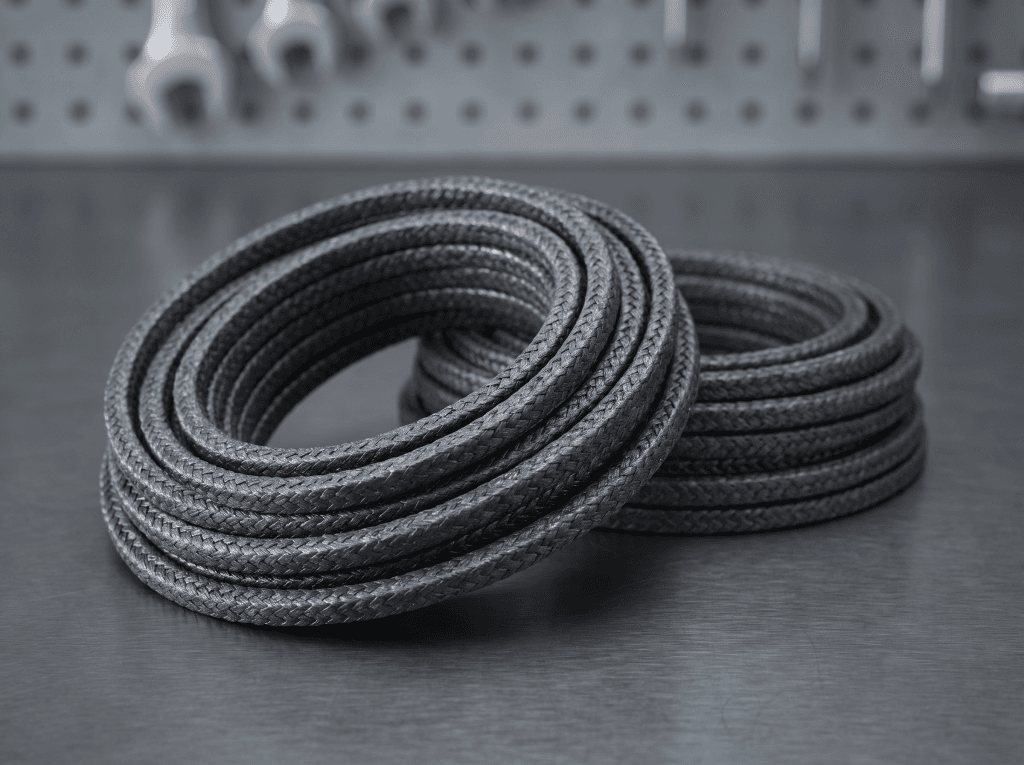
Most gland packing failures we see traced back to one decision: PTFE or graphite base, chosen by habit rather than by the actual operating conditions. Both materials are excellent — for different jobs — and understanding where each one wins makes the selection straightforward.
The core difference: chemistry versus heat
Pure PTFE Gland Packing is built for chemical inertness — it resists the full pH 0–14 range and won’t contaminate the process, which is why it’s the default for food, pharmaceutical and aggressive-chemical duty. Its ceiling is temperature: around 260°C continuous.
Graphite Gland Packing is built for heat and self-lubrication — rated to 450°C on rotating equipment and up to roughly 650°C on valves — and is also chemically resistant across the same pH range, but it can’t match PTFE’s cleanliness for hygienic or ultra-pure applications, and it conducts electricity, which occasionally matters in instrumentation service.
When PTFE is the right call
- Food, dairy or pharmaceutical product-contact pumps and valves, where food-grade white PTFE grades apply
- Aggressive acids, caustics or solvents where any metal or graphite contamination is unacceptable
- Applications under 260°C where a clean, low-friction seal matters more than raw heat resistance
When graphite is the right call
- Steam, boiler feed and hot-water service above what PTFE can handle
- High-pressure valves, where Graphite Packing with Inconel Wire adds mechanical reinforcement against extrusion
- Continuous high-temperature duty where self-lubrication reduces shaft wear over long run times
The middle ground: when neither is quite right
Not every application sits cleanly at one extreme. For abrasive slurries — cane juice, mineral processing, pulp — Aramid Gland Packing resists extrusion and abrasion better than either PTFE or graphite alone, and is often paired as end rings around a softer core. For general, non-aggressive service where cost matters more than ultimate performance, Acrylic PTFE Packing gives PTFE-like cleanliness at a lower price point, and Carbon Fiber Packing bridges toward graphite’s heat range with less thermal conductivity.
A quick decision table
| Condition | Choose |
|---|---|
| Food/pharma, any pH, <260°C | Pure PTFE Gland Packing |
| Steam/boiler, >260°C | Graphite Gland Packing |
| High-pressure valve, extrusion risk | Graphite Packing with Inconel Wire |
| Abrasive slurry | Aramid Gland Packing |
| General duty, cost-sensitive | Acrylic PTFE Packing |
Frequently asked questions
Can PTFE and graphite packing be mixed in the same stuffing box? It’s unusual and generally not recommended — the materials behave differently under compression, which can cause uneven sealing.
Does graphite packing conduct heat into the bearing? Yes, more than PTFE — on bearing-sensitive equipment this is worth checking with us before specifying.
Is there a PTFE grade that handles higher temperatures? Not meaningfully above 260°C — beyond that point, graphite-based packing is the correct direction regardless of grade.
Tell us the media, temperature and pressure on your application and we’ll confirm whether PTFE or graphite — or a specific hybrid grade — is the right fit before you order.