
October 13, 2026
Polyester Wadding vs Polyester Felt vs Wool Felt: Which Do You Actually Need?
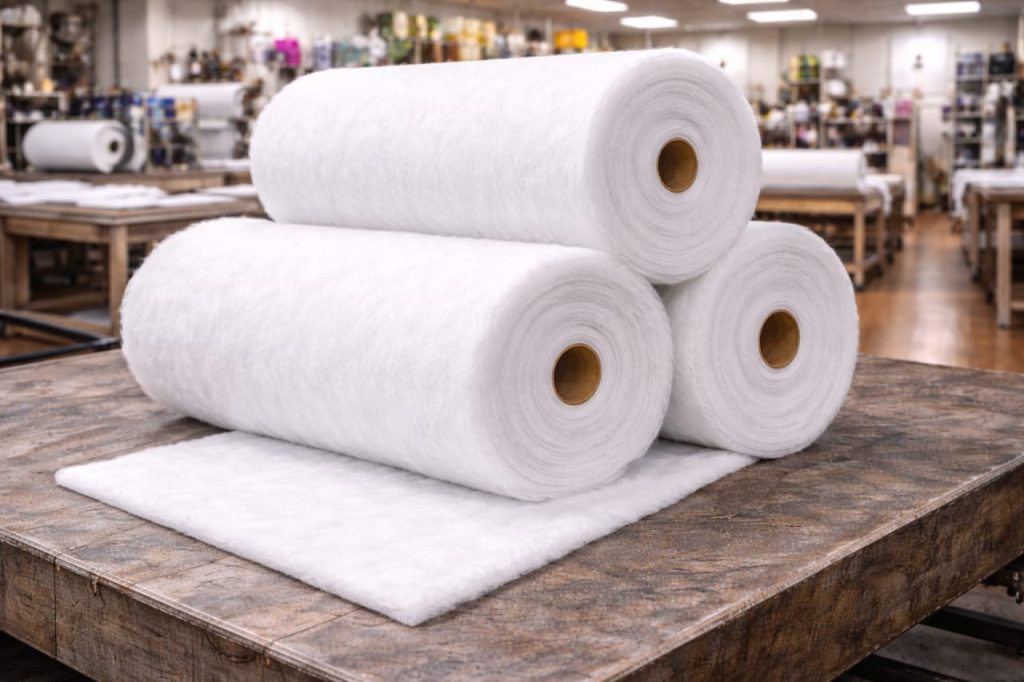
Polyester wadding, polyester felt and wool felt are all non-woven mats of pressed fibre, and all three get ordered in place of one another. They are not interchangeable. Polyester wadding is an air filter, polyester felt is a padding and wicking material, and wool felt is a dense mechanical material for polishing, seals and damping.
Quick comparison
| Product | What it is | Specified for | Where it fails |
|---|---|---|---|
| Polyester wadding filter | Progressively-dense non-woven air filter media, by the roll | Coarse / pre-filtration in air handling | Fine particulate, smoke, fumes, liquids, hot gas |
| Polyester felt | Bonded polyester non-woven, economical, wide thickness range | Padding, fluid retention, wicking, general filtration | Polishing, oil seals, heavy vibration damping |
| Wool felt | Natural wool matted under heat and pressure — hard and dense | Polishing, oil seals, wicks, gaskets, anti-vibration pads | Anywhere the density is not needed — you are overpaying |
| Non-woven geotextile | Needle-punched engineering fabric, graded by weight (gsm) | Separation, drainage, erosion control, membrane protection | Any indoor mechanical or filtration duty |
Polyester wadding filter
A coarse pre-filter, graded G3–G4 / ISO Coarse. Its job is to protect the expensive bag filter or cartridge behind it — skip it and you blind the costly element far more often. It is not a fine, HEPA or fume filter. Polyester also tops out around 100–130 °C, so it is not a hot gas medium. For liquids and slurry you need rotary filter cloth instead.
Polyester felt
Polyester felt is the economical general-purpose choice for padding, wicking and light filtration. Its strength is chemistry rather than mechanics: excellent ageing and oxidiser resistance, good resistance to most mineral and organic acids, and solid dry-heat performance. Check the chemical compatibility chart if your process fluid is the governing constraint.
Wool felt
Wool felt is specified when density is the requirement. That density is what lets it polish steel and marble without gouging, hold lubricant in oil seals and wicks, and damp vibration under machinery. It costs more than polyester — and if your application is padding or general filtration, you are paying for a property you are not using. We will tell you so.
Non-woven geotextile
Non-woven geotextile is a civil engineering fabric, not an indoor product. It passes water while retaining soil, which makes it a separator between aggregate and subgrade, a drainage filter, and a cushion protecting membranes from puncture. UV stabilised, stable across roughly pH 2–13, and graded by weight.
What to tell us
- The job — filtration, padding, wicking, polishing, sealing, damping or ground works.
- Air or liquid, if it is filtration. This alone rules out half the options.
- Continuous operating temperature, not peak — see the heat resistance chart.
- Thickness, width, or the dimensions it has to suit.
Indicative properties only. Grade, weight and density vary; confirm against the datasheet for the grade we quote before specifying from them.