
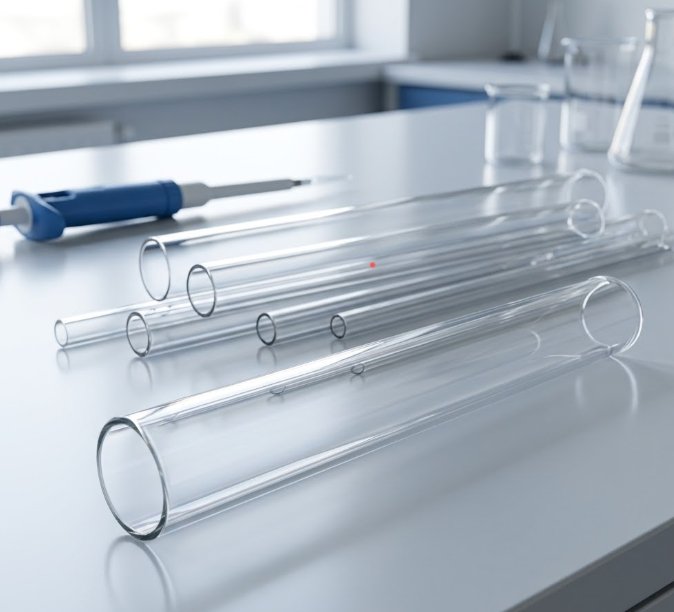
Borosilicate Glass Tube
Borosilicate glass has a wide variety of uses ranging from cookware to lab equipment as well as a component of high quality products such as implantable medical devices and devices used in space exploration.It is widely used in the field of semiconductor,Metallurgy,Chemical industry,Electric light source,Photo-communication,Medical equipment,Scientific instruments and so on.These type of glass tubes can withstand temperatures upto 800c. There transformation temperature is 500c,Softening point is 800c and working point is 1250c. These tubes are available in different thickness and widths depending on customer demand.
- Very low thermal expansion — resists thermal shock
- Withstands continuous service to ~800°C
- Excellent chemical resistance to acids, water & solvents
- Optically clear — lab, sight-glass, lighting & instruments
Overview
Borosilicate glass tube is the industrial and laboratory glass of choice wherever ordinary soda-lime glass would crack under heat or attack from chemicals. Its defining property is a very low coefficient of thermal expansion: it barely changes size as it heats and cools, so it shrugs off the sudden temperature swings — thermal shock — that shatter ordinary glass. That single characteristic is why the same material appears in laboratory glassware, boiler gauge glass, high-temperature sight glasses and lighting.
The working temperatures are genuinely high for a glass. Borosilicate has a transformation point around 500°C and a softening point around 800°C, and it can be used continuously up to roughly 800°C with a much higher short-term working point. Combined with its chemical durability — it resists water, acids, salt solutions and most solvents — this makes it stable in service conditions that would fog, corrode or deform lesser glasses.
The range of uses is unusually broad. Borosilicate tube goes into the semiconductor and metallurgy industries, chemical process equipment, electric light sources and photo-communication, medical and pharmaceutical devices, and scientific instruments — anywhere that needs a transparent, heat-stable, chemically inert conduit or envelope. In sealing and instrumentation it is the material behind reflex and transparent liquid-level gauges and boiler gauge glass.
We supply borosilicate tube in a range of diameters and wall thicknesses to suit the application — from thin-wall tube for instruments and lighting to heavier-wall tube for pressure and sight-glass duty. Tell us the bore, wall thickness and length you need, and the service temperature and pressure, and we will match the right specification.
Specifications
Typical properties of borosilicate 3.3 glass tube. Exact ratings depend on wall thickness and whether the glass is annealed or toughened — confirm against pressure/temperature duty.
| Property | Value | Test Standard |
|---|---|---|
| Material | Borosilicate glass (low-expansion, ~3.3 type) | — |
| Transformation Temperature | approx. 500°C | — |
| Softening Point | approx. 800°C | — |
| Working Point | approx. 1250°C (short term) | — |
| Continuous Service | up to ~800°C | — |
| Thermal Expansion | Very low — high thermal-shock resistance | — |
| Chemical Resistance | Excellent to water, acids, salts, solvents | Weak to HF & hot strong alkali |
| Clarity | Optically clear / transparent | — |
| Dimensions | Range of bore & wall thickness | To order |
| Forms | Plain tube, cut lengths | — |
Applications
Where a transparent tube or envelope must survive heat, thermal shock or chemical attack.
Downloads
Frequently Asked Questions
Why choose borosilicate over ordinary glass?
Because of thermal shock. Ordinary soda-lime glass expands and contracts a lot with temperature, so a sudden hot/cold change cracks it. Borosilicate has a very low thermal expansion, so it takes rapid temperature swings and direct heat without shattering — and it resists chemicals far better.
What temperature can it handle?
It can be used continuously to around 800°C, with a softening point near 800°C and a short-term working point around 1250°C. The transformation point is around 500°C. For continuous high-heat duty, confirm the exact grade and wall thickness with us.
Is borosilicate glass chemically resistant?
Yes — it resists water, acids, salt solutions and most solvents very well, which is why it is the standard laboratory and chemical-process glass. Its main weaknesses are hydrofluoric acid, which dissolves glass, and hot concentrated alkalis.
Can it be used for boiler gauge glass?
Yes. Borosilicate is the glass used in reflex and transparent liquid-level gauges. For a complete level-gauge assembly see our Reflex Gauge Glass and Plain Gauge Glass.
What sizes are available?
A range of bore diameters and wall thicknesses, in cut lengths. Thin-wall tube suits instruments and lighting; heavier wall suits pressure and sight-glass duty. Tell us bore, wall and length plus the service temperature and pressure.
Can it be toughened for higher strength?
Yes — in a toughened form the mechanical and thermal strength is increased significantly over annealed glass. Specify the duty (pressure, temperature, impact) and we will advise whether annealed or toughened is appropriate.
Need a quote or a spec check?
Send us your operating conditions and we will confirm the right grade for the job.
Not sure this is the right material?
Launch the Solution Finder