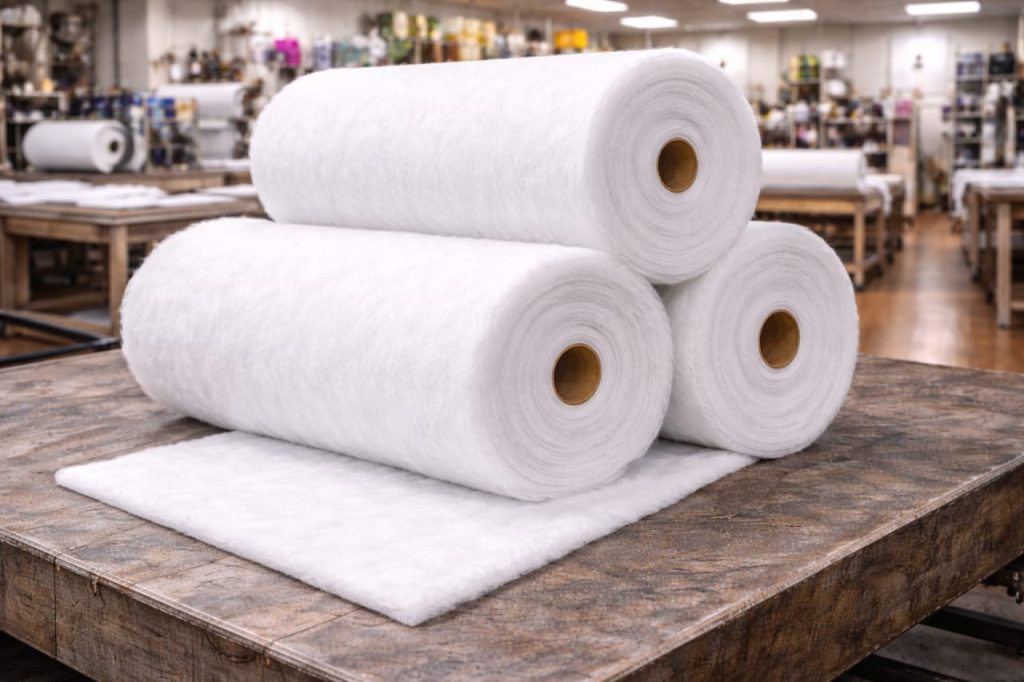
Polyester wadding or batting is a layer of insulation used in quilting between a top layer of the upholstery ticking and a bottom layer of the backing material.It is also used for duvets as it is washable and suitable for people with allergies. Thermobonded polyester wadding has some unique features that include right weight/volume ratio for styling and designing,Exceptional dimension and volume stability and fiber uniformity.Polyester wadding is widely used in power plants for insulation purposes.Due to their superior characteristics of filtration the most common use of polyester wadding can be found in the manufacturing of fuel seperators and air seperators for engines and compressors.
Coarse / pre-filter media — protects the expensive filter downstream
Progressively-dense structure holds a lot of dust before it blocks
Polyester wadding is a non-woven synthetic filter medium supplied in rolls and cut to whatever size your filter frame needs. It is the workhorse coarse filter and pre-filter of air handling: the first stage that catches the big stuff — dust, lint, fibres, insects, sand — before the air reaches anything finer.
Its real economic job is to protect what is behind it. The fine filter, bag filter or cartridge downstream is expensive; the polyester wadding in front of it is cheap and disposable. If the pre-filter is doing its work, the expensive filter lasts far longer and the fan works less hard. A plant that skips the pre-filter to save money almost always spends more, because it blinds and replaces the costly downstream filter far more often. Changing a cheap pre-filter regularly is the single most cost-effective thing you can do for an air handling system.
Be clear about what this is not. It is a coarse filter. It is not a fine filter, not a HEPA filter, and not a fume or gas filter — it will not capture fine respirable particulate, smoke or vapour, and it should not be specified as though it will. It is also an air filter medium: for liquid and slurry filtration you need Rotary Filter Cloth, which is an entirely different product selected to the slurry chemistry and particle size.
Specifications
Typical properties for progressively-dense polyester non-woven filter wadding. Grade, weight and efficiency class vary — tell us the application and airflow and we will match the media.
Polyester filter wadding is made by laying non-woven polyester fibres into a lofted mat and bonding them, typically thermally. The key design feature is that the mat is progressively dense: it is deliberately open and lofty on the face the air enters, and progressively tighter towards the exit face.
That structure is what gives it its high dust-holding capacity, and it is the whole point of the material. Large particles are trapped in the open entry layers while smaller ones penetrate further before being caught, so dust is distributed through the depth of the medium rather than forming a blocking cake on the surface. A uniform-density medium of the same weight would blind far sooner. This is why a good pre-filter can hold a surprising amount of dirt before its pressure drop climbs.
The fibre is polyester, which does not rot, resists moisture and is dimensionally stable — but which also sets the temperature ceiling at roughly 100–130 °C. This is not a hot-gas filter medium.
Grades, Thickness & Supply
Supplied on rolls and cut to size, so it fits any filter frame — which is one of its main practical advantages over pre-made panel filters.
Thickness
Character
Typical Use
~10 mm
Light, low pressure drop
Light-duty pre-filter, panel filters
~15 mm
Light-medium
General AHU pre-filter
~20 mm
Medium — common general grade
General air handling pre-filter
~25 mm
Medium, higher dust capacity
Dustier environments
~30 mm
Heavy, high dust capacity
Dusty industrial intake
~40 mm
Heavy
Very dusty environments, paint booths
~50 mm
Very heavy
Heavy dust loading, coarse intake screens
Standard roll widths of 1 m and 2 m; cut to your frame size on request. Tell us the frame dimensions, the airflow and how dusty the environment is, and we will match the grade and thickness.
Applications
The first line of defence in any air handling system — and the cheapest thing in it.
HVAC Pre-FiltersThe standard first stage in air handling units, protecting the fine filters, coils and fan behind it. Changing this cheap filter regularly is what keeps the expensive one alive.
Air Intake ScreensFresh-air intakes and louvre screens, catching insects, leaves, lint and coarse airborne dust before it enters the plant.
Paint Booth FiltrationIntake filtration for spray booths, where incoming dust would land in wet paint and ruin the finish. Higher-thickness grades are used for their dust-holding capacity.
Compressor & Machine IntakesProtecting compressors, generators and machinery intakes from dust and debris ingestion, which is a common cause of premature wear.
Dust Collection Pre-FiltrationA coarse first stage in dust-collection and extraction systems, taking the bulk load off the bag or cartridge filters downstream.
Textile & Lint-Heavy EnvironmentsTextile mills, laundries and any environment producing large volumes of lint and fibre, which would rapidly blind a fine filter without a pre-filter in front of it.
Industries
Why Polyester Wadding Filter is specified in each of the industries we serve.
HVAC & Building Services
Every air handling unit needs a pre-filter, and polyester wadding is the standard, economical choice. The value case is genuinely simple and is worth spelling out to anyone tempted to economise: the pre-filter costs very little, and the fine filter behind it costs a great deal. If the pre-filter is changed on schedule, the fine filter lasts far longer, the coils stay clean, and the fan does not have to fight a rising pressure drop — which is itself an energy cost. Plants that skip or neglect the pre-filter invariably spend more, because they end up replacing the expensive downstream filter far more frequently and running the fan against a dirty system. Being cut from the roll to any frame size is a practical bonus: you are not restricted to whatever panel sizes happen to be stocked.
Textile Mills
A textile mill generates enormous quantities of lint and airborne fibre, and it will blind a fine filter astonishingly quickly if there is nothing in front of it. Polyester wadding pre-filters are essential rather than optional in this environment, and thicker, higher-capacity grades are usually justified because of the sheer dust loading. The economics are stark in a mill: the pre-filter may need changing frequently, but it is cheap, whereas the downstream filter it protects is not. This is also the environment where the progressive-density structure of the media earns its keep — lint is trapped through the depth of the mat rather than forming a blocking mat on the surface, so the filter keeps working for far longer than a uniform-density medium of the same weight would.
General Manufacturing
Compressors, generators, machine tools and process equipment all take in air, and all of them wear out faster if that air is full of dust. A coarse polyester pre-filter on the intake is one of the cheapest pieces of preventive maintenance available — it is a consumable costing very little that protects machinery costing a great deal. In paint and finishing operations it also protects product quality directly, since dust drawn into a spray booth lands in wet paint and ruins the finish, and a rejected panel costs far more than a filter. The key thing to understand about specifying it is what it does not do: this is coarse filtration, and it will not capture fine respirable particulate, welding fume or solvent vapour. Those require entirely different filtration technology.
Polyester Wadding vs Other Filter Media
These are not interchangeable. Choose on what you are filtering — and note that liquid filtration is a different product entirely.
Property
Polyester Wadding
Fine / Bag Filter
Rotary Filter Cloth
Geotextile Felt
Medium
Air
Air
Liquid / slurry
Liquid / drainage
Filter Class
Coarse (G3–G4)
Fine (F7–F9, HEPA)
Process-matched
Coarse
Captures Fine Particulate
No
Yes
Yes (by weave)
No
Captures Fumes / Gas
No
No (needs carbon)
No
No
Max Temperature
~100–130°C
Varies
Varies
Varies
Cost
Low
High
Medium
Low
Role
Protects the fine filter
Final air quality
Slurry dewatering
Drainage / separation
Advantages & Limitations
Advantages
Very low cost — and it protects far more expensive filters downstream.
High dust-holding capacity, thanks to the progressively-dense structure.
Low initial pressure drop, so it does not penalise fan energy when clean.
Cut to any size from the roll — fits any filter frame, no need to match a stock panel size.
Polyester does not rot and resists moisture.
Quick and simple to change, with no tools required.
Available in a range of thicknesses to suit the dust loading.
Limitations
Coarse filtration only. It will not capture fine respirable particulate, smoke, fumes or gas. It is not a HEPA or fine filter and must not be specified as one.
It is an air filter medium, not a liquid filter. For slurry and process liquid filtration, use Rotary Filter Cloth, which is selected to the slurry chemistry and particle size.
Temperature ceiling of roughly 100–130°C — polyester. Not a hot-gas filter medium.
Generally disposable rather than washable — washing degrades the loft that gives it its dust-holding capacity.
Must be changed on schedule; a blinded pre-filter raises pressure drop and makes the fan work harder, which costs energy.
Not suitable for filtering aggressive chemical vapours.
Installation, Storage & Maintenance
Installation
Cut the media to fit the frame with a small margin so it seats snugly with no air bypass around the edges — a gap at the edge lets unfiltered air straight past, and a filter that is bypassed is doing nothing at all. Fit it with the open, lofty face towards the incoming air and the denser face downstream; fitted the wrong way round it blinds far faster and holds much less dust. Make sure the retaining frame or clips hold it firmly, since the airflow will otherwise pull it out of position.
Storage
Store rolls flat or upright in a clean, dry place, in their wrapping, and away from dust — a filter medium that has been sitting uncovered in a dirty store has already used up part of its life before it is fitted. Do not compress the rolls under heavy weight, as the loft is what gives the medium its dust-holding capacity and a crushed medium will not perform.
Maintenance
Change it on a schedule, and change it before it blinds. This is the single most cost-effective maintenance action in an air handling system. A dirty pre-filter raises the pressure drop across the system, which makes the fan work harder (an ongoing energy cost) and lets more load through to the expensive fine filter behind it. The right check is pressure drop, not appearance — a filter can look dirty and still be working well, or look acceptable and already be restricting airflow. If you have a manometer or pressure gauge across the filter bank, use it.
Buying Guide
What to tell us so we quote the right grade first time.
Air or liquid? This is an air filter medium. If you are filtering a process liquid or slurry, you need Rotary Filter Cloth instead — a completely different product matched to your slurry chemistry and particle size.
Do you need coarse or fine filtration? This is coarse media. It catches dust, lint and insects. It will not catch fine respirable particulate, smoke or fumes. If you need those captured, you need a fine or HEPA filter — polyester wadding is the pre-filter that protects it.
Frame size. Give us the dimensions and we will cut it to fit. Being cut from the roll means you are not restricted to stock panel sizes.
How dusty is the environment? Heavier dust loading (a textile mill, a paint booth, a dusty intake) justifies a thicker, higher-capacity grade — it will hold more dirt and need changing less often.
What is the air temperature? Polyester tops out at roughly 100–130°C. For hot gas you need a different medium entirely.
Airflow rate. Affects the pressure drop and how quickly the filter loads. Tell us and we will advise on grade and thickness.
Standards & Compliance
EN 779 — historic classification of coarse and fine air filters (G3/G4 coarse classes).
ISO 16890 — current international standard for air filter classification (ISO Coarse).
Non-woven polyester media with a progressively-dense structure for high dust-holding capacity.
Supplied on rolls (typically 1 m and 2 m widths) and cut to size to fit any filter frame.
Note: this is a coarse/pre-filter medium. It is not a HEPA, fine, fume or gas filter, and should not be specified as one.
What does polyester wadding filter actually catch?
Coarse particulate — dust, lint, fibres, sand, insects. It is a coarse / pre-filter medium (G3–G4 / ISO Coarse).
Will it capture fine dust or fumes?
No. It is coarse media. It will not capture fine respirable particulate, smoke, welding fume or solvent vapour. If you need those captured you need a fine, HEPA or carbon filter — and polyester wadding is the pre-filter that goes in front of it to protect it.
Is it a HEPA filter?
No, and it should never be specified as one. It is a coarse pre-filter. HEPA is an entirely different class of filtration.
Why do I need a pre-filter at all?
Economics. The pre-filter is cheap and the fine filter behind it is expensive. A pre-filter changed on schedule dramatically extends the life of the costly downstream filter, keeps coils clean and keeps the fan from fighting a rising pressure drop. Skipping it almost always costs more, not less.
Can I use it to filter liquid or slurry?
No. This is an air filter medium. For liquid and slurry filtration you need Rotary Filter Cloth, which is selected specifically to your slurry chemistry and particle size.
Which way round should it be fitted?
With the open, lofty face towards the incoming air and the denser face downstream. The media is progressively dense by design. Fitted backwards it blinds much faster and holds far less dust.
What is "progressively dense" and why does it matter?
The mat is open on the air-entry face and tighter towards the exit. That means dust is captured through the depth of the medium rather than caking on the surface, which is what gives it its high dust-holding capacity. A uniform-density medium of the same weight would blind much sooner.
How often should I change it?
On a schedule, and before it blinds. The proper indicator is pressure drop across the filter, not how dirty it looks. A blinded pre-filter makes the fan work harder, which costs energy continuously.
Can I wash and re-use it?
Generally no — it is designed to be disposable. Washing degrades the loft that gives it its dust-holding capacity, so a washed filter performs noticeably worse.
What thickness do I need?
Around 20 mm is the common general grade. Go thicker (30–50 mm) for dusty environments like textile mills, paint booths and dirty intakes — more capacity means less frequent changes.
What temperature can it handle?
Roughly 100–130°C — that is the polyester limit. It is not a hot-gas filter medium.
Can you cut it to my frame size?
Yes — that is one of its main advantages. It comes on rolls and is cut to size, so you are not restricted to stock panel dimensions. Just send us your frame measurements.
Why is my filter blinding so quickly?
Either the environment is dustier than the grade was chosen for (use a thicker, higher-capacity media), or it has been fitted the wrong way round (dense face into the airflow), or the change interval is simply too long for the dust loading.
What happens if air bypasses around the edges?
The filter does nothing. Unfiltered air going around the media is exactly as bad as having no filter at all. Cut it to seat snugly with no gaps and make sure the frame or clips hold it firmly.
Does it rot or absorb moisture?
No — polyester does not rot and has low moisture absorption, which is one reason it is preferred over natural-fibre media.
Will it filter chemical vapours?
No. Vapour and gas capture requires activated carbon or a chemical filter medium. Polyester wadding is purely a mechanical particulate filter.
What class of filter is it?
Coarse — G3 to G4 under the old EN 779 classification, or ISO Coarse under the current ISO 16890 standard.
Is a thicker filter always better?
Not always — a thicker medium holds more dust but also has a higher pressure drop. Match the thickness to the actual dust loading rather than defaulting to the thickest available.
How should I store it?
Flat or upright, clean, dry and wrapped. Do not compress the rolls under weight — the loft is what does the filtering, and a crushed medium will not perform. A filter stored uncovered in a dirty store has already used up part of its life.
What is the cheapest way to improve my air handling system?
Honestly? Change the pre-filter on schedule. It is the lowest-cost, highest-return maintenance action available — it protects the expensive filter, keeps the coils clean and keeps fan energy down.
Can I order Polyester Wadding Filter from outside Lahore?
Yes. We are based in Lahore and supply polyester wadding filter across Pakistan, including Karachi, Rawalpindi, Islamabad, Multan, Faisalabad and Sialkot. Delivery is by road freight. Give us the width, thickness and quantity plus your city and we will come back with carriage and lead time.
Need a quote or a spec check?
Send us your operating conditions and we will confirm the right grade for the job.