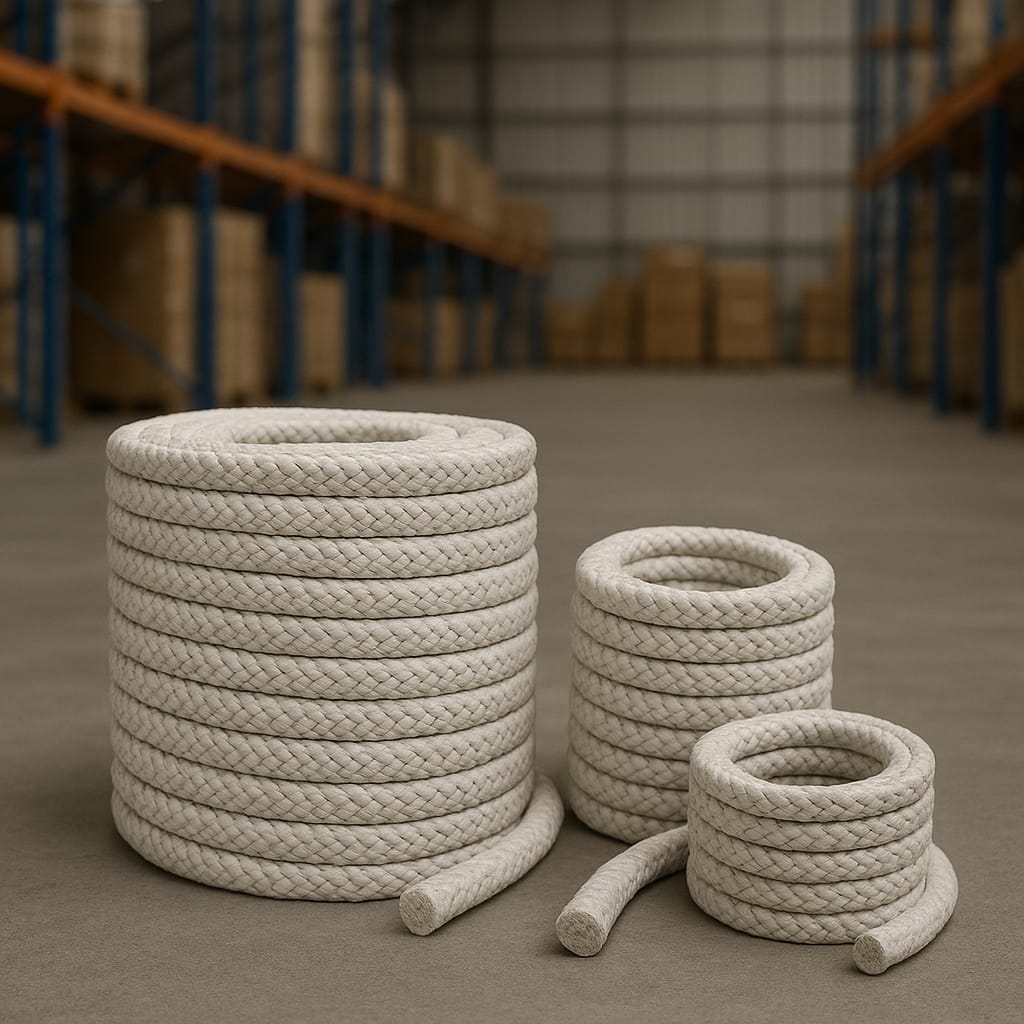
It is made of long asbestos fiber yarn and braided into round form extensively used as heat insulation materials on thermal installations and heat conduction systems operated at temperatures upto 250 c and the loss on ignition is 32% max.This type of rope finds its extensive application in sealing the doors of ovens or kiln in order to prevent heat loss.The sizes available range from 3mm-25mm.
Asbestos-free alternatives are available and usually better — see below
Please read this section before ordering. Asbestos is a regulated carcinogen. Its use is banned or heavily restricted in many jurisdictions, and inhaling its fibres causes serious, irreversible lung disease. We supply asbestos rope only for legacy maintenance where it is specifically called for, and we would rather sell you the asbestos-free alternative — which, for almost every application, is the better product anyway.
The asbestos-free alternative is not a compromise — it is an upgrade.Glass rope handles around 550 °C, and ceramic fibre products go far beyond that. Asbestos rope is rated 250–550 °C depending on grade — so at best it merely matches glass rope, and at worst it is considerably worse. There is very rarely a genuine technical reason to choose asbestos over glass rope. If someone has told you that you need asbestos because it takes more heat, that is simply not correct.
Asbestos rope is a braided or twisted cord traditionally used to seal gaps: furnace and oven doors, boiler access hatches, flue joints, and expansion gaps in hot equipment. It compresses into an irregular gap and holds a seal against heat. Everything it does, glass rope does at least as well.
If you are removing old asbestos rope from existing equipment, that is the highest-risk task in its life cycle. Disturbing aged asbestos releases fibres. Follow your local regulations, use proper respiratory protection, keep the material damp to suppress dust, and dispose of it as regulated asbestos waste — never in general waste.
Specifications
Typical properties for asbestos rope. Note that the temperature rating varies substantially by grade — a general "asbestos = high temperature" assumption is wrong, and this is exactly why the grade matters.
Property
Value
Test Standard
Health Classification
Regulated carcinogen — see safety notes
—
Recommended Alternative
Glass Rope (~550°C, asbestos-free)
—
Material
Braided / twisted asbestos fibre
—
Max Temperature
250 – 550°C (grade-dependent)
—
Form
Round or square section rope / cord
—
Standard Diameters
6 mm – 50 mm
—
Compressibility
Good — conforms to irregular gaps
—
Resilience
Springs back to maintain a seal under compression
—
Combustibility
Non-combustible
—
Chemical Resistance
Good against most media; attacked by strong acids
—
Typical Use
Furnace / oven door seals, flue joints, gap packing
Asbestos rope is produced by braiding or twisting asbestos fibre into a round or square cord. The braided structure allows it to compress into an irregular gap and spring back enough to maintain a seal, which is what made it a traditional choice for furnace and oven door sealing.
The temperature capability varies significantly with the grade and the fibre content, which is why a blanket assumption that "asbestos means high temperature" is misleading. Lower grades top out around 250 °C — considerably less than glass rope. Only the higher grades approach 550 °C, which is where glass rope sits anyway.
The modern equivalent is made the same way from glass fibre or ceramic fibre instead of asbestos, giving the same braided cord with the same compressibility and sealing behaviour, at the same or better temperature rating, with none of the health risk. Functionally, it is a drop-in replacement.
Diameters & Availability
Rope is sized by the gap it has to fill. Before ordering, please consider glass rope in the same size — it is asbestos-free, takes the same or higher temperature, and fits the same gap.
Diameter
Typical Gap / Use
Asbestos-Free Equivalent
6 mm
Small door seals, tight joints
Glass Rope 6 mm
8 mm
Oven door seals
Glass Rope 8 mm
10 mm
Furnace door seals
Glass Rope 10 mm
12 mm
Furnace / boiler door seals
Glass Rope 12 mm
16 mm
Larger door gaps, flue joints
Glass Rope 16 mm
20 mm
Large gaps, access hatches
Glass Rope 20 mm
25 mm
Large gaps
Glass Rope 25 mm
30 mm
Very large gaps
Glass Rope / Ceramic Fibre
40 mm
Very large gaps
Glass Rope / Ceramic Fibre
50 mm
Expansion joints
Ceramic Fibre products
We will happily quote the asbestos-free equivalent alongside any asbestos rope enquiry — just ask. In most cases it is the same price bracket, performs the same or better, and removes the health and disposal burden entirely.
Chemical Resistance
Asbestos fibre is chemically stable against most media, but it is attacked by strong acids. Note that chemical performance is rarely the reason anyone chooses asbestos — and the asbestos-free alternatives are comparable here too.
Medium
Resistance
Notes
Hot Air & Flue Gases
Good
Traditional furnace-door duty
Steam
Good
Suitable within temperature limit
Mineral Oils
Good
Generally resistant
Alkalis
Good
Resistant
Strong Acids
Poor
Attacks asbestos fibre
Water
Fair
Absorbs moisture; dries out
General guidance for the material family at normal industrial concentrations. See the full Chemical Compatibility Chart, and confirm your exact chemical, concentration and temperature with us before final selection.
Applications
Traditional gap-sealing rope for hot equipment. In every one of these applications, glass rope is a direct asbestos-free replacement.
Furnace & Oven Door SealsThe classic use — compressed into the door channel to seal against heat loss. Glass rope does this identically at up to 550°C, asbestos-free.
Boiler Access HatchesSealing inspection doors and access hatches on boilers and hot vessels. Again, glass rope is a direct replacement.
Flue & Duct JointsPacking joints in flue pipework and hot ducting to prevent gas leakage. Glass rope or ceramic fibre rope replaces it directly.
Expansion Gap PackingFilling expansion gaps in refractory and hot equipment. For higher temperatures, ceramic paper or ceramic fibre rope is the modern answer.
Legacy Equipment MaintenanceWhere an existing installation was originally built with asbestos rope and a like-for-like replacement is specified. Even here, an asbestos-free upgrade is usually possible — ask us.
Industries
Why Asbestos Rope is specified in each of the industries we serve.
Legacy Industrial Maintenance
The honest answer about who buys asbestos rope today is: people maintaining old equipment that was originally built with it, in jurisdictions where its use is still permitted. We supply it for that purpose. But we would encourage anyone in that position to take the opportunity to upgrade rather than replace like-for-like, because the asbestos-free alternative is genuinely better. Glass rope handles around 550 °C — equal to or higher than most asbestos rope grades — it fits the same gap, it compresses and seals the same way, and it eliminates the health risk to your maintenance staff and the regulated-waste disposal burden. There is very rarely a technical reason to stay with asbestos, and the belief that asbestos necessarily takes more heat than the alternatives is simply mistaken.
Furnaces, Boilers & Kilns
Furnace and oven door sealing is the traditional home of asbestos rope, and it is worth being precise about what it actually does there. The rope compresses into the door channel and holds a seal against heat and gas leakage. That job depends on compressibility, resilience and heat resistance — and glass rope and ceramic fibre rope have all three, at the same or better temperature ratings. For anything above 550 °C, neither asbestos nor glass rope is the right answer and ceramic fibre products are required, so at the genuinely hot end asbestos is not even in contention. The practical upshot is that across the entire temperature range in which door-sealing rope is used, an asbestos-free product does the job at least as well.
Safety & Removal Work
If you are working on old equipment that already contains asbestos rope, the most important thing on this page is this: removing aged asbestos is the highest-exposure task in its entire life cycle. Old rope is friable — it crumbles — and disturbing it releases respirable fibres directly into the air you are breathing. Follow your local asbestos regulations, which in many jurisdictions require licensed personnel for this work. Use proper respiratory protection rather than a dust mask, keep the material damp to suppress fibre release, do not use power tools or brushes on it, bag it as regulated asbestos waste, and never put it in general waste. Then replace it with an asbestos-free rope so that the next person to open that door does not face the same risk.
Asbestos Rope vs Asbestos-Free Alternatives
This table is the whole argument. The asbestos-free options match or beat asbestos rope on temperature, with none of the health or disposal burden.
Property
Asbestos Rope
Glass Rope
Ceramic Fibre Rope
Max Temperature
250 – 550°C
~550°C
Far higher (1260°C class)
Contains Asbestos
Yes — carcinogen
No
No
Health Risk
Serious
Fibre irritation only
Fibre precautions needed
Disposal
Regulated hazardous waste
General waste
General waste
Compressibility / Sealing
Good
Good
Good
Fits Same Gap
—
Yes — drop-in
Yes
Regulatory Burden
High / banned in many places
None
None
Recommendation
Legacy only
Use this instead
For >550°C
Advantages & Limitations
Advantages
Good compressibility — conforms to irregular gaps and holds a seal.
Non-combustible.
Chemically stable against most media (except strong acids).
Long-established in legacy equipment, so like-for-like replacement is straightforward where specified.
Note honestly: every one of these advantages is shared by asbestos-free glass rope, which also takes the same or higher temperature.
Limitations
Asbestos is a regulated carcinogen. Inhaling its fibres causes serious, irreversible lung disease. Its use is banned or heavily restricted in many jurisdictions.
Removing old asbestos rope is high-risk — aged material is friable and releases fibres when disturbed. Licensed personnel may be legally required.
Must be disposed of as regulated asbestos waste — never in general waste.
Temperature rating is often lower than people assume — 250°C for lower grades, which is far below glass rope’s ~550°C.
Attacked by strong acids.
There is rarely any technical reason to choose it — the asbestos-free alternatives match or exceed it in every practical respect.
Installation, Storage & Maintenance
Installation
Wear proper respiratory protection, gloves and eye protection. Avoid cutting, sawing or brushing the rope dry — damp it down first to suppress fibre release. Do not use power tools on it. Press the rope into the door channel or gap and compress it evenly; it should fill the gap and spring back enough to seal. Clean up any debris with a damp cloth, not a brush or compressed air (both of which make fibres airborne), and bag all waste as regulated asbestos waste. Before you start: seriously consider fitting glass rope instead — it installs identically and eliminates all of the above.
Storage
Keep asbestos rope in sealed, clearly labelled packaging, separated from general stores, and only where local regulations permit it to be held. Do not store it loose, where it can be disturbed, abraded or shed fibres. Restrict access. Keep records as your local regulations require.
Maintenance
Removal is the highest-exposure task — treat it as such. Aged asbestos rope becomes friable and crumbles, releasing fibres directly into the breathing zone of whoever opens that door. Follow your local asbestos regulations (which may require licensed personnel), use proper respiratory protection, damp the material down before disturbing it, and dispose of it as regulated asbestos waste. When you replace it, replace it with an asbestos-free rope so that the person who next services that equipment is not exposed at all.
Buying Guide
What to tell us so we quote the right grade first time.
First: do you actually need asbestos? Almost certainly not. Glass rope handles ~550°C — equal to or better than asbestos rope — fits the same gap, seals the same way, and has no health or disposal burden. Ask us to quote it and compare.
What is the actual temperature? This matters, because asbestos rope grades vary from 250°C to 550°C. If your duty is under 550°C, glass rope covers it. If it is over 550°C, asbestos will not do the job either — you need ceramic fibre.
What is the gap size? Rope diameter is chosen to fill and compress into the gap. Give us the gap dimension and we will size it — in asbestos-free material if you are willing.
Is asbestos legal for this use in your jurisdiction? This is your responsibility to confirm. Asbestos use is banned or restricted in many places. We will not supply it where we understand it to be prohibited.
Do you have the required PPE and disposal route? Respiratory protection, gloves, eye protection, and a regulated asbestos waste disposal route are all needed. If you do not have these, that is another strong reason to use the asbestos-free alternative.
Are you removing existing asbestos rope? Tell us — this is the highest-risk task, and your local regulations may require licensed personnel. We can supply the asbestos-free replacement.
Standards & Compliance
SAFETY: Asbestos is a regulated carcinogen. Its supply and use are banned or heavily restricted in many jurisdictions. It is the buyer’s responsibility to confirm that its use is lawful for their application and location.
PPE required: proper respiratory protection (not a nuisance dust mask), gloves and eye protection when handling, cutting or removing.
Disposal: must be disposed of as regulated asbestos waste in accordance with local regulations. Never place in general waste.
Removal of existing asbestos may legally require licensed personnel in your jurisdiction — check before starting work.
Asbestos-free alternatives are available and recommended:Glass Rope (~550°C) and ceramic fibre rope (far higher). We will quote these alongside any asbestos enquiry.
Honestly, almost certainly not. Glass rope handles around 550°C — equal to or better than asbestos rope — fits the same gap, seals the same way, and carries none of the health risk or disposal burden. We would rather sell you that.
Is asbestos dangerous?
Yes. It is a regulated carcinogen. Inhaling its fibres causes serious, irreversible lung disease, and its use is banned or heavily restricted in many jurisdictions. This is not a formality — it is the single most important fact about this product.
Does asbestos rope take more heat than glass rope?
No — this is a common and important misconception. Asbestos rope is rated 250–550°C depending on grade. Glass rope handles around 550°C. So at best asbestos merely matches it, and lower asbestos grades are considerably worse.
What is the asbestos-free alternative?
For up to about 550°C, Glass Rope — a direct drop-in replacement in the same diameters. Above that, ceramic fibre rope. Both fit the same gap and seal the same way.
Is the asbestos-free version worse in any way?
For furnace and oven door sealing, no. It compresses and seals the same way, at the same or higher temperature. The honest answer is that there is rarely any technical reason to choose asbestos.
What temperature can asbestos rope handle?
250 to 550°C, depending heavily on the grade. The assumption that "asbestos means high temperature" is wrong — lower grades are limited to 250°C, well below glass rope.
What PPE do I need to handle it?
Proper respiratory protection (not a nuisance dust mask), gloves and eye protection. Damp the material down before cutting or disturbing it to suppress fibre release.
How do I dispose of asbestos rope?
As regulated asbestos waste, in accordance with your local regulations. Never in general waste. If you do not have a compliant disposal route, that is another good reason to use the asbestos-free alternative.
I need to remove old asbestos rope. What should I know?
This is the highest-risk task in the material’s life cycle. Aged rope is friable and releases fibres when disturbed. Your local regulations may legally require licensed personnel. Use proper respiratory protection, damp it down, do not use power tools or brushes, bag it as regulated waste, and replace it with an asbestos-free rope.
Can I just vacuum or brush up the debris?
No. Brushing, sweeping and compressed air all make fibres airborne, which is exactly what you must avoid. Use a damp cloth and bag everything as regulated asbestos waste.
Is asbestos legal where I am?
That is for you to confirm — it is banned or heavily restricted in many jurisdictions, and the rules differ by country. We will not supply it where we understand its use to be prohibited.
Why do you still supply it?
For legacy maintenance where it is specifically called for and lawful. But we will always quote the asbestos-free alternative alongside, and we would rather you took it.
What size rope do I need?
It is sized to fill and compress into the gap. Give us the gap dimension — and we will quote the glass rope equivalent in the same size.
Does asbestos rope resist chemicals?
It is stable against most media but is attacked by strong acids. Chemical performance is rarely why anyone chooses it, and the alternatives are comparable here too.
What do I use above 550°C?
Ceramic fibre products — neither asbestos rope nor glass rope will survive above that. At the genuinely hot end, asbestos is not even a contender.
Is it non-combustible?
Yes, it is non-combustible. So are the asbestos-free alternatives.
How should I store it?
In sealed, clearly labelled packaging, separated from general stores, with restricted access, and only where local regulations permit. Do not store it loose where it can be disturbed and shed fibres.
Can you supply the asbestos-free equivalent instead?
Yes, and we would prefer to. Tell us the diameter and temperature and we will quote glass rope or ceramic fibre rope — usually in the same price bracket, with no health or disposal burden.
Does asbestos rope seal pressure?
No — it is a heat and gas seal for door gaps and joints, not a pressure seal. For pressure sealing you need a gasket or packing product.
What is the single most important thing on this page?
That you almost certainly do not need asbestos. Glass rope matches or beats it on temperature, does the same job, and will not harm the person installing it or the person who removes it in ten years.
Need a quote or a spec check?
Send us your operating conditions and we will confirm the right grade for the job.