
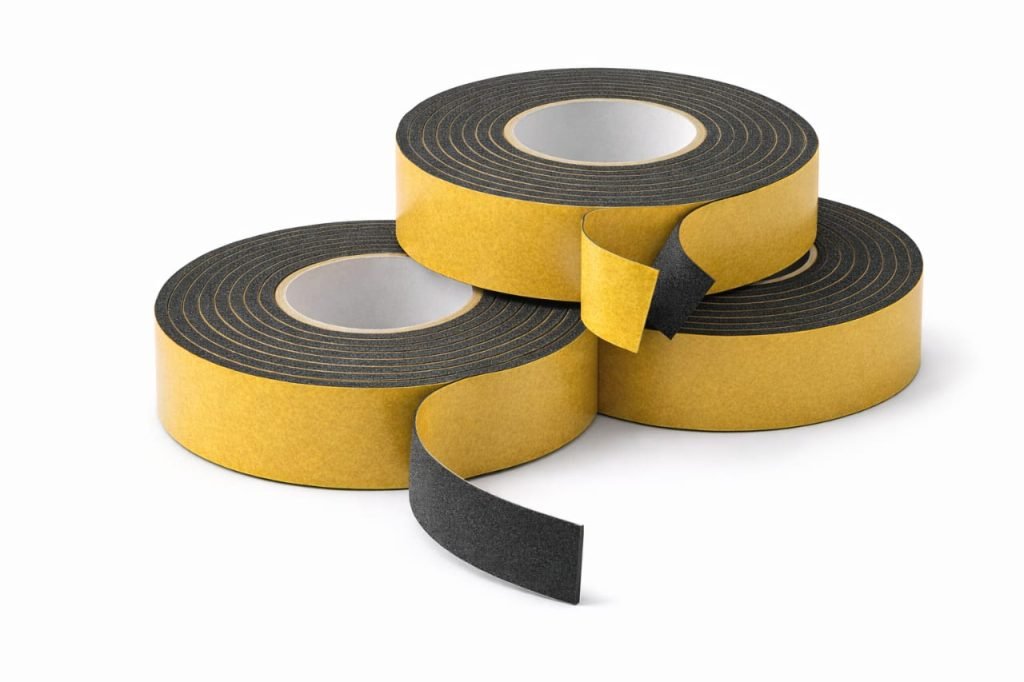
Foam Rubber Tape
Foam tapes are used for sound dampening,Insulating,Gasketing,Cushioning/padding and sealing and are designed to enhance the appearance and improve the overall performance of your product design.Foam tape resists moisture,Ultraviolet rays from the sun and solvents providing high bonding strength to compensate for different thermal expansions.Foam tapes are ideal for use in appliances,Automotive applications,Electrical/electronics,Shower and bath,Truck/trailer/RV,Point-of-purchase signage,Window fabrication and plastic molder/extruder applications.
- Seals, cushions, insulates & damps sound — one self-adhesive tape
- Compresses to fill gaps and follow uneven surfaces
- Resists moisture, UV and solvents
- Self-adhesive with high bond strength
Overview
Foam rubber tape is a strip of flexible closed- or open-cell foam, usually supplied self-adhesive, that does several jobs at once: it seals gaps against draughts, dust and water; it cushions and pads to protect surfaces and absorb impact; it insulates; and it damps sound and vibration. Because the foam compresses, it seals and cushions against surfaces that are uneven or not perfectly parallel — something a rigid gasket cannot do.
That gap-filling ability is the point of a foam tape. Where two parts do not meet cleanly — a rattling panel, an ill-fitting lid, a shower screen against tile, a window frame against masonry — the foam compresses to take up the tolerance and forms a soft, continuous seal. The self-adhesive backing is formulated for a high initial bond that holds through temperature swings and the different thermal expansion of the two surfaces it bridges.
It is deliberately durable in exposed conditions: it resists moisture, the sun's UV, and solvents, so it holds up outdoors and in wet and chemically active environments rather than perishing quickly. That is what lets the same basic product serve everything from a bathroom seal to a truck-body gasket.
The applications span domestic and industrial work — appliances, automotive, electrical and electronics enclosures, shower and bath sealing, truck, trailer and RV bodies, point-of-purchase signage, window fabrication, and plastic moulding and extrusion. Tell us the gap you need to fill, whether it is indoor or exposed, and the width and thickness, and we will match the right foam grade.
Specifications
Typical properties of self-adhesive foam rubber tape. Cell type, density and thickness are chosen from the sealing and cushioning duty.
| Property | Value | Test Standard |
|---|---|---|
| Material | Flexible foam rubber | Open or closed cell |
| Functions | Sealing, cushioning, insulating, sound damping | — |
| Backing | Self-adhesive, high bond strength | — |
| Moisture Resistance | Yes | Suits wet / exposed use |
| UV Resistance | Yes | Suits outdoor use |
| Solvent Resistance | Yes | — |
| Compressibility | High — fills uneven gaps | — |
| Widths & Thicknesses | Range to suit gap size | To order |
| Supply | Rolls | — |
Applications
Wherever a soft, compressible seal or cushion has to bridge an imperfect gap.
Downloads
Frequently Asked Questions
What does foam rubber tape actually do?
Four things at once: it seals gaps against draughts, dust and water; it cushions and protects surfaces; it insulates; and it damps sound and vibration. Because it compresses, it does all of this even where the two surfaces are uneven.
Is it self-adhesive?
Yes — standard supply is self-adhesive with a high-strength backing formulated to hold through temperature changes and the different expansion of the two surfaces it bridges. Clean and dry the surface before applying for the best bond.
Will it survive outdoors?
Yes — it is made to resist moisture, UV and solvents, so it holds up in wet, sunny and chemically exposed conditions rather than perishing quickly like a basic foam.
Open cell or closed cell — which do I need?
Closed-cell foam is the choice where you need a genuine water/air seal; open-cell is softer and better for pure cushioning and sound absorption. Tell us the job and we will supply the right type.
How do I pick the thickness?
Match it to the gap: the tape should be a little thicker than the widest gap it has to fill so it stays compressed and keeps sealing. Send us the gap range and we will advise thickness and width.
Can it be used as a gasket?
Yes — it is widely used as a soft gasket where a rigid gasket cannot follow the surface, for example on covers, panels, lids and enclosures that are not perfectly flat.
Do you deliver Foam Rubber Tape outside Lahore?
Yes. We are based in Lahore and supply foam rubber tape across Pakistan, including Karachi, Rawalpindi, Islamabad, Multan, Faisalabad and Sialkot. Delivery is by road freight. Give us the width, thickness and total length plus your city and we will come back with carriage and lead time.
Need a quote or a spec check?
Send us your operating conditions and we will confirm the right grade for the job.
Not sure this is the right material?
Launch the Solution Finder