
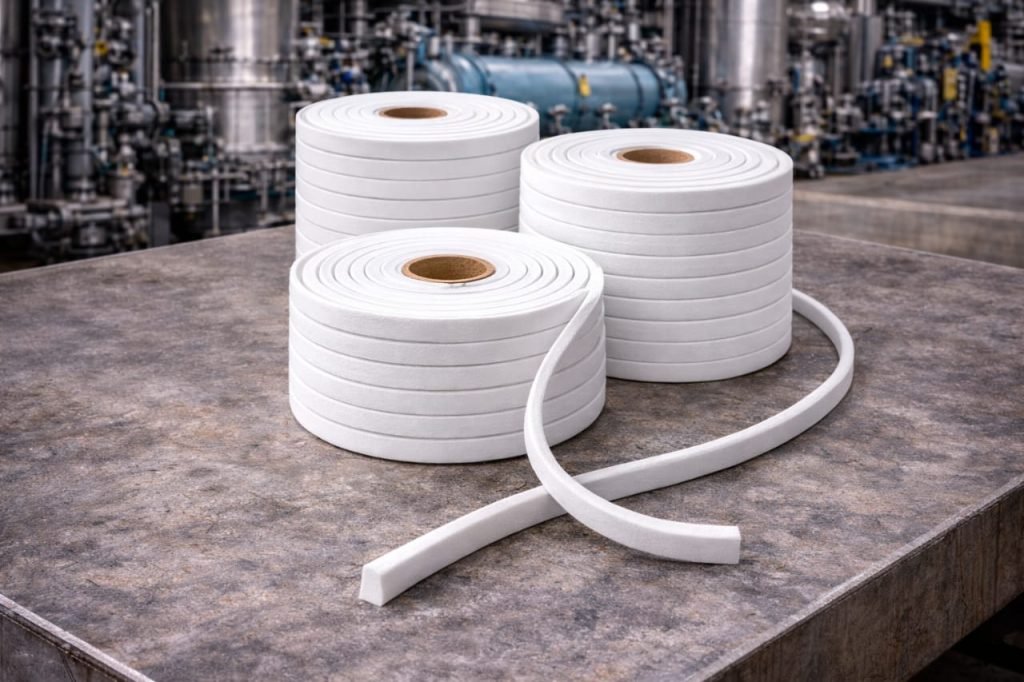
PTFE Joint Sealant
100% pure expanded PTFE Sealants with self-adhesive.It is an ideal sealant for most pipe fitting and equipment's flanges sealing.The main advantage of PTFE joint sealant is that it requires no precutting and no wasteful scrap which saves time and money when sealing large equipment flanges.Since it is so versatile and inert to most chemicals so it is perfect for the most challenging chemical application. PTFE Joint sealant is a Universal sealing material for valves and it also serve as a flange gasket and box packing.
- Expanded-PTFE (ePTFE) cord with a self-adhesive backing
- Conforms to irregular, warped or glass-lined flange surfaces
- Chemically inert across the full pH 0–14 range
- Rated to around 260°C, simplifying large or non-standard joints
- Compresses in place — no cut gasket profile needed
Overview
PTFE Joint Sealant is a flexible expanded-PTFE cord with a self-adhesive backing that forms a conformable gasket in place on flanges, manways and irregular surfaces. It is chemically inert and seals uneven, warped or glass-lined joints where a cut gasket would fail.
It compresses to fit the flange, handles the full pH 0–14 range up to about +260°C, and greatly simplifies gasketing of large or non-standard joints.
Specifications
| Material | Expanded PTFE (ePTFE) cord |
|---|---|
| Max Temperature | 260°C |
| pH Range | 0 – 14 |
| Form | Self-adhesive cord (various widths) |
| Use | In-place form-in gasket |
Applications
Industries Served
Commonly specified across:
Frequently Asked Questions
What is PTFE Joint Sealant used for?
It forms a gasket in place on flanges and irregular joints, sealing warped, glass-lined or non-standard surfaces where cut gaskets leak.
What temperature can PTFE Joint Sealant handle?
Being expanded PTFE, it is rated across pH 0–14 up to about 260°C.
How is PTFE Joint Sealant applied?
Its self-adhesive cord is laid around the flange face, overlapped at the ends, and compressed as the joint is bolted up.
Download the PTFE Joint Sealant Datasheet
Full specifications, applications and industries served — in one PDF for your records or to share with your team.
Related PTFE Products
View all PTFE Products →


Need a quote or a spec check?
Send us your operating conditions and we'll help you source the right PTFE Joint Sealant for the job.
Not sure this is the right material?
Launch the Solution Finder