
October 13, 2026
Dust Control and Sealing in Grain Handling and Flour Mills
Flour milling and grain handling present a sealing problem that most process industries do not: the dust is abrasive, it gets everywhere, and in the right concentration it is explosive. Material selection here is driven less by temperature and chemistry than by abrasion, containment and housekeeping.
Why grain dust is different
Grain and flour dust is fine, dry and highly mobile. It works into every clearance, abrades seals from the outside in, and accumulates on ledges and inside enclosures. Unlike a wet process where leakage is visible and contained, a dust leak spreads through the building and lands everywhere — which is both a product loss and a housekeeping burden.
It is also combustible. Suspended in air at the right concentration and given an ignition source, grain dust explodes. That single fact reorders the priorities: containment at source is a safety control, not just good practice, and anything that generates heat near accumulated dust needs attention.
Sealing conveyors and elevators
Bucket elevators, screw conveyors and belt transfer points are where dust escapes. Seals here are fighting abrasion rather than pressure or heat. The failure mode is wear: a seal that starts tight is worn open within months, and the leak grows quietly.
Rubber sheet cut into skirting and transfer-point seals covers most of this duty, and the grade matters — a harder grade lasts longer against abrasion but conforms less well to an uneven chute lip. For rotating shafts through enclosure walls, packed glands using an abrasion-resistant packing such as aramid gland packing outlast softer grades considerably.
Shaft condition is the hidden cost
Abrasive dust does not only destroy the seal; it scores the shaft. Once a shaft is grooved, every subsequent set of packing wears out faster, and the interval shortens each time. Check shaft condition at every repack — see the measurement guide — and deal with a scored sleeve rather than fitting harder packing to compensate, which accelerates the damage.
Access doors, inspection hatches and enclosures
These leak more than people expect because they are opened regularly and the seal is rarely replaced on a schedule. Cut gaskets from rubber sheet or use foam rubber tape on doors that need a compliant seal against a slightly uneven frame. Foam tape is quick to apply and quick to renew, which matters on a door opened daily.
Separating areas without blocking traffic
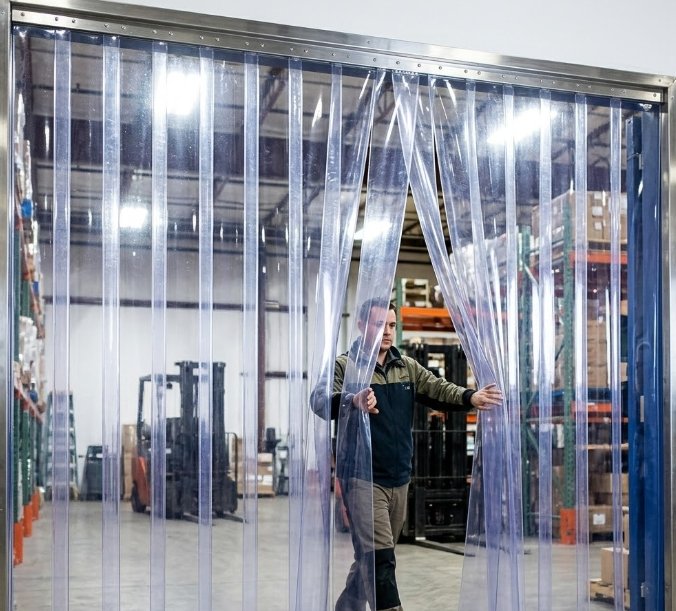
PVC strip curtains are used to separate dusty areas from packing halls and to keep flour out of circulation areas while forklifts and trolleys keep moving. They also help hold temperature and keep birds and insects out of storage. The strip curtain calculator sizes the strips and overlap for a doorway, and choosing the right PVC strip curtain covers grade selection.
Dryers, boilers and the hot side
Mills with grain dryers and boiler houses have a conventional high-temperature insulation requirement alongside the dust work — glass wool on steam and dryer ducting, rope and tape lagging around flanges and valves. Keep insulation surfaces clean: lagging that accumulates a layer of flour dust in a hot area is a hazard, not just untidy.
What we would ask before quoting
- Where the dust is escaping — transfer points, elevator boots, screw conveyor glands or access doors.
- Shaft and stuffing box dimensions, and whether shafts are scored.
- Doorway sizes and traffic type for any curtain work.
- Whether the area is classified for dust explosion risk, and any resulting material constraints.
- Hot-side scope — dryers, boilers and steam lines — with continuous operating temperatures.
Tell us which of those is actually costing you money today and we will quote against that rather than the whole list.