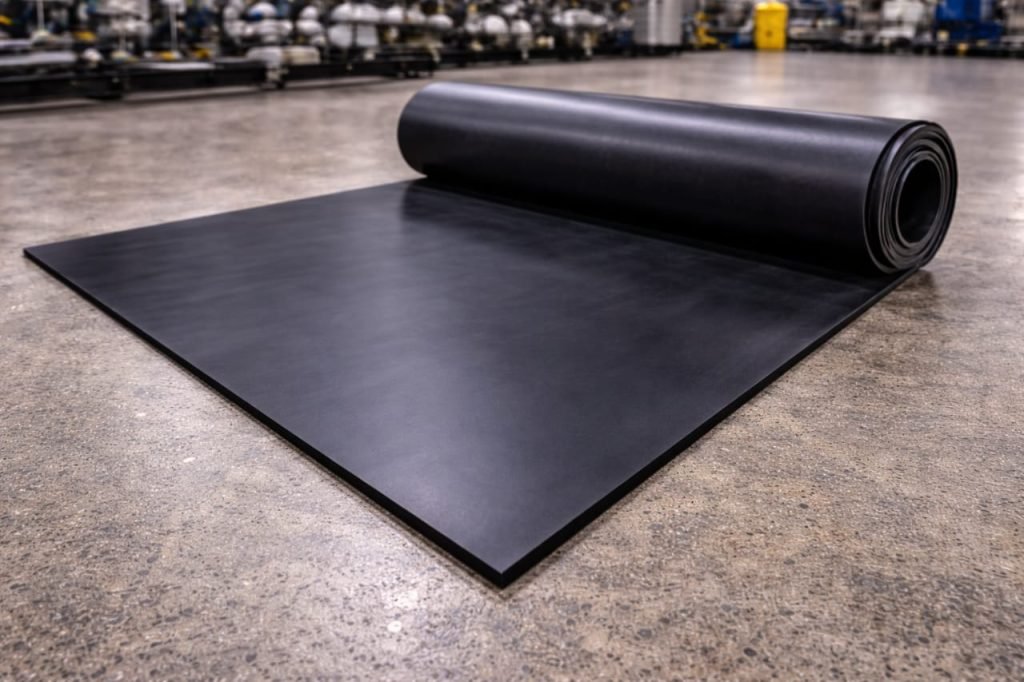
Rubber sheet is supplied in several grades that look identical but behave completely differently: SBR for general duty, NBR for oil and fuel, EPDM for steam and outdoor weather, Neoprene, Silicone and Viton for specialised service. The grade decides everything. It is cut into flange and manhole gaskets, tank and chute linings, anti-vibration matting and wear strips, in thicknesses from 1 mm to 25 mm and roll widths of 1 m to 1.4 m. Tell us the media and the temperature and we will confirm the correct grade.
Six grades — SBR, NBR, EPDM, Neoprene, Silicone, Viton
“Rubber sheet” is not a material — it is a family of materials that look identical and behave completely differently. A black rubber sheet might be SBR, NBR, EPDM, Neoprene, Silicone or Viton, and you cannot tell them apart by looking. The grade decides everything: what it resists, how hot it can run, how long it lasts. Everything else on this page is secondary to getting that one choice right.
The most expensive mistake in the field is not thickness or hardness — it is grade. EPDM swells and fails in petroleum oil, yet it is superb in steam and outdoors. NBR is excellent in oil and fuel, yet it cracks within a season if you leave it in sunlight and ozone. These two errors, in these two directions, account for most of the rubber sheet failures we see. If you tell us the media and the temperature, we will tell you the grade.
Once the grade is settled, rubber sheet is one of the most useful materials in a plant. It is cut into flange and manhole gaskets, used to line tanks and chutes against wear and corrosion, laid as anti-vibration matting and machine pads, and made into wear strips, seals and skirting. We supply it in thicknesses from 1 mm to 25 mm, in rolls 1 m to 1.4 m wide, plain or fabric-reinforced, and cut to your drawing where you need shapes rather than sheet.
Specifications
Rubber sheet properties are grade-dependent. The table below gives the general commercial range across grades; see the grade comparison further down for the figures that actually matter to your selection.
Plain, or fabric-inserted (1–3 ply) for pressure duty
—
Food Grade
White food-grade EPDM / Silicone / Nitrile available
—
Supply Form
Rolls, cut sheets, or gaskets cut to your drawing
—
Properties in Detail
Physical Properties
Hardness
40 – 90 Shore A (60–70 typical)
Thickness
1 mm – 25 mm
Tensile Strength
~4 – 20 MPa (grade dependent)
Elongation at Break
~200 – 600%
Abrasion Resistance
Excellent in Natural / SBR
Media Resistance
Petroleum Oil & Fuel
NBR & Viton excellent — EPDM fails
Steam & Hot Water
EPDM excellent — NBR poor
Acids & Alkalis
EPDM & Viton good
Ozone, UV & Weather
EPDM excellent — NBR cracks
Food Contact
White food-grade EPDM / Silicone / Nitrile
Temperature by Grade
Silicone
−60°C to +230°C
Viton (FKM)
−20°C to +200°C
EPDM
−45°C to +150°C
Neoprene (CR)
−35°C to +100°C
NBR (Nitrile)
−30°C to +100°C
SBR
−40°C to +80°C
Manufacturing
Rubber sheet is produced by calendering a compounded elastomer into a continuous sheet of controlled thickness, then vulcanising it under heat and pressure to cure the rubber into its final elastic state. The compound — the base polymer plus fillers, curatives and process aids — is what determines whether the finished sheet resists oil, steam, ozone or abrasion. Two sheets that look identical can have completely different compounds behind them.
For pressure duty, sheet can be supplied fabric-inserted: one to three plies of textile reinforcement are calendered into the rubber. The insert restrains the rubber from extruding under bolt load or line pressure, which is why insertion sheet is used for higher-pressure flange gaskets and manhole covers where plain rubber would creep and blow out.
Thicknesses & Roll Sizes
Supplied in rolls, cut sheets, or as finished gaskets cut to your drawing. Working out how many gaskets you get from a sheet? Our Gasket Sheet Usage Calculator does the nesting maths for you.
Thickness
Typical Use
Availability
1 mm
Thin gaskets, shims, protective linings
Stock
1.5 mm
Light gaskets, sealing strips
Stock
2 mm
General gaskets, flange seals
Stock
3 mm
Flange gaskets — the most common size
Stock
4 mm
Flange gaskets, manhole seals
Stock
5 mm
Manhole gaskets, tank linings
Stock
6 mm
Linings, matting, heavier gaskets
Stock
8 mm
Chute linings, wear protection
Stock
10 mm
Anti-vibration matting, linings
Stock
12 mm
Heavy linings, skirting rubber
Stock
15 mm
Heavy wear linings
To order
20 mm
Heavy-duty wear and impact linings
To order
25 mm
Maximum standard thickness
To order
Roll widths 1.0 m, 1.2 m and 1.4 m; typical roll length 10 m. Send us a drawing and we will supply cut gaskets rather than sheet, which saves you the cutting and the offcut waste.
Chemical Resistance
This is the section that matters most. Resistance is a property of the grade, not of “rubber”. The single most common and most expensive error is fitting EPDM to a petroleum oil line — it swells and fails — or fitting NBR outdoors, where ozone and UV crack it within a season. Tell us the media and we will tell you the grade. Our Chemical Compatibility Chart covers this in full.
Medium
Resistance
Notes
Petroleum Oil, Fuel & Grease
Excellent
NBR or Viton. NEVER EPDM — it swells and fails
Steam & Hot Water
Excellent
EPDM is the correct grade — NBR is poor here
Ozone, UV & Outdoor Weather
Excellent
EPDM or Neoprene — NBR cracks outdoors
Dilute Acids & Alkalis
Good
EPDM or Viton
Strong Acids / Aggressive Chemicals
Good
Viton — or use a PTFE product instead
Abrasive Slurry & Wear
Excellent
Natural rubber or SBR — best abrasion resistance
Food & Beverage Contact
Good
White food-grade EPDM, Silicone or Nitrile
High Temperature (to 230°C)
Excellent
Silicone — but it has poor abrasion resistance
Solvents & Ketones
Fair
Grade critical — ask us before ordering
Plain Water & General Duty
Excellent
SBR — the economical commercial grade
General guidance for the material family at normal industrial concentrations. See the full Chemical Compatibility Chart, and confirm your exact chemical, concentration and temperature with us before final selection.
Applications
Rubber sheet does four jobs in a plant: it seals, it lines, it cushions, and it wears out so something more expensive does not.
Flange & Manhole GasketsThe most common use. Cut from sheet to suit the flange, or supplied ready-cut to your drawing. For higher pressure, fabric-inserted sheet resists the bolt load without extruding the way plain rubber would.
Tank & Chute LiningsRubber lining protects steel from abrasion and corrosion, and it is far cheaper to replace a lining than the vessel behind it. Natural rubber and SBR give the best abrasion resistance; EPDM handles the chemistry.
Anti-Vibration Matting & PadsLaid under machinery, compressors and pumps to absorb vibration and damp noise, and to protect floors and foundations. For dedicated mounting duty see our Rubber Pad.
Oil & Fuel SealingNBR (Nitrile) is the grade for petroleum oil, diesel, fuel and grease service to around 100°C. It is one of the few grades that will not swell in hydrocarbons.
Steam & Outdoor DutyEPDM handles steam, hot water and hot outdoor exposure to around 150°C, and it is effectively immune to ozone and UV — which is exactly why it is the right grade for anything left outside.
Wear Strips & Skirting RubberConveyor skirting, wear strips and impact pads, where the rubber is deliberately the sacrificial part. Natural rubber and SBR are the best abrasion performers here.
Industries
Why Rubber Sheet is specified in each of the industries we serve.
Chemical Plants
In a chemical plant, rubber sheet is specified almost entirely on media compatibility, and the failures we are asked to diagnose are nearly always grade errors rather than thickness or hardness errors. EPDM is superb against dilute acids, alkalis, steam and hot water, and it is the workhorse grade across most process lines — but it must be kept away from petroleum oils, where it swells until it fails. For genuinely aggressive chemistry, and particularly where temperature is high as well, Viton is the grade that holds up, at a significantly higher cost per square metre. Where the chemistry is severe enough that no elastomer is comfortable, the honest answer is usually not a rubber sheet at all but a PTFE-based product, and we will tell you so rather than sell you a gasket that will fail.
Water & Wastewater Treatment
Treatment plants are the ideal application for rubber sheet, and they are also where the money is most often wasted by over-specifying. Most of the plant is handling water, and for flange gaskets, manhole covers and tank seals in that service, commercial SBR sheet does the job perfectly at the lowest cost. Where the duty moves outdoors — exposed pipework, launder covers, anything sitting in sunlight — EPDM should be used instead, because ozone and UV will crack an SBR or NBR sheet within a season and the failure looks like a mystery until you know to expect it. The chemical dosing lines are a separate problem again and need the grade matched to the specific chemical. Three grades, correctly placed, will cover an entire plant.
Textile Mills
Textile processing puts rubber sheet under two very different loads in the same building. On the dyeing and bleaching side, the media is hot, wet and chemically active, and EPDM is the grade that survives it — standard commercial sheet degrades quickly in that environment. On the mechanical side, in spinning and weaving, rubber sheet is cut into cots, aprons, pads and wear components where the requirement is abrasion resistance and consistent resilience, and natural rubber or SBR is the correct choice. It is worth treating them as two separate specifications rather than buying one grade for the whole mill; the cost difference is small and the life difference is not.
Food & Beverage Processing
In food and beverage production the rubber sheet is a product-contact material, which raises the specification well above general industrial duty. White food-grade EPDM, silicone and nitrile grades are used for gaskets, seals and linings because they will not taint, discolour or shed into the product, and because they survive the caustic and acidic clean-in-place cycles that hygienic lines are washed down with — a cycle that quietly destroys standard commercial rubber. Silicone is the grade to reach for where the process runs hot, since it holds up to around 230°C. Tell us at the point of order that the application is food contact so the correct grade is supplied and the conformity documentation comes with it, because retro-fitting the paperwork after delivery is not possible.
Rubber Sheet Grade Comparison
This is the table that matters. Read the oil row and the steam/weather row before anything else — they are where the costly mistakes are made.
Property
SBR
NBR (Nitrile)
EPDM
Neoprene (CR)
Silicone
Viton (FKM)
Max Temperature
80°C
100°C
150°C
100°C
230°C
200°C
Min Temperature
−40°C
−30°C
−45°C
−35°C
−60°C
−20°C
Petroleum Oil / Fuel
Poor
Excellent
FAILS
Good
Poor
Excellent
Steam & Hot Water
Poor
Poor
Excellent
Fair
Fair
Good
Ozone / UV / Weather
Poor
Poor — cracks
Excellent
Good
Excellent
Excellent
Acids & Alkalis
Fair
Fair
Good
Good
Fair
Excellent
Abrasion Resistance
Excellent
Good
Good
Good
Poor
Fair
Food Grade Available
No
Yes (white)
Yes (white)
No
Yes (white)
Limited
Relative Cost
Lowest
Low–Medium
Medium
Medium
High
Highest
Choose It For
General duty, water, abrasion, lowest cost
Oil, fuel, grease
Steam, weather, outdoors, chemicals
Weather + moderate oil
Extreme temperature, food
Aggressive chemicals + heat
Advantages & Limitations
Advantages
Six grades covering oil, steam, weather, chemicals, extreme temperature and abrasion — one product family, most sealing problems.
Cheap and fast to cut on site: gaskets, linings, pads and strips all come out of the same sheet.
Available fabric-inserted for pressure duty, where plain rubber would extrude under bolt load.
Excellent abrasion resistance in Natural / SBR grades — a sacrificial lining is far cheaper than the vessel behind it.
Food-grade white EPDM, Silicone and Nitrile available for product-contact duty.
We can supply gaskets cut to your drawing rather than sheet, removing both the cutting labour and the offcut waste.
Limitations
The grade is everything, and grades are not interchangeable. A black rubber sheet tells you nothing by looking at it. Fitting the wrong grade is the single biggest cause of failure.
EPDM swells and fails in petroleum oil. This is the most common and most expensive mistake we see. Use NBR or Viton for oil and fuel.
NBR cracks outdoors. It has poor ozone and UV resistance, so it will craze and split in sunlight within a season. Use EPDM or Neoprene for anything exposed.
Plain rubber sheet creeps and extrudes under high bolt load — specify fabric-inserted sheet for higher-pressure flanges.
Silicone has excellent temperature range but poor abrasion and tear strength — it is not a wear material.
Rubber is not a high-temperature material in general. Above about 230°C, no rubber grade will serve; you need a different product family entirely.
Installation, Storage & Maintenance
Installation
Cut gaskets slightly oversize and trim to the flange rather than cutting undersize — a gasket that does not reach the bolt circle will blow out. Ensure both flange faces are clean and free of the old gasket before fitting; most “gasket failures” are actually dirty-face failures. Tighten bolts in a criss-cross (star) pattern in stages, not one bolt at a time to full torque, so the sheet compresses evenly. Do not over-torque: rubber is a soft gasket material and crushing it destroys the seal rather than improving it. For linings, ensure the substrate is clean and dry and use the correct adhesive system for the grade. See our rubber sheet installation guide.
Storage
Store rolls flat or hanging, in a cool, dry, dark place. Keep rubber away from direct sunlight, ozone sources and electric motors — motors generate ozone, and ozone attacks rubber in storage exactly as it does in service, particularly NBR and SBR. Do not store rolls under heavy compressive load, which sets a permanent deformation into the sheet, and keep it away from oils and solvents that would swell the wrong grade before it ever reaches the job.
Maintenance
Inspect rubber gaskets and linings for the two classic failure signatures, because each tells you something different. Swelling, softening or a spongy feel means the media is chemically attacking the grade — almost always an EPDM sheet that has met petroleum oil, and replacing it with the same grade will simply repeat the failure. Fine surface cracking or crazing means ozone and UV attack — typically NBR or SBR left outdoors, and the fix is to move to EPDM rather than to fit the same sheet again. Hardening and loss of elasticity usually means heat exposure beyond the grade limit. In every case, read the failure before reordering.
Buying Guide
What to tell us so we quote the right grade first time.
What is the media? This is the first and most important question. Oil or fuel → NBR. Steam, hot water or outdoors → EPDM. Aggressive chemicals plus heat → Viton. Plain water and general duty → SBR. Get this wrong and nothing else matters.
What is the operating temperature? It sets the grade ceiling: SBR 80°C, NBR and Neoprene 100°C, EPDM 150°C, Viton 200°C, Silicone 230°C.
Is it exposed to sunlight or outdoor weather? If yes, do not use NBR or SBR — ozone and UV will crack them. Use EPDM or Neoprene.
Thickness and hardness. 3 mm is the most common flange gasket thickness; 60–70 Shore A is the usual hardness. Tell us the duty and we will advise if yours should differ.
Is there significant bolt load or line pressure? If yes, ask for fabric-inserted sheet. Plain rubber will creep and extrude out of a heavily bolted flange.
Is this a food or beverage contact application? Say so at the point of order — white food-grade EPDM, silicone and nitrile are specific grades, and conformity documentation must be arranged before we ship.
Do you want sheet, or finished gaskets? Send us a drawing and we will cut the gaskets for you. It removes both the cutting labour and the offcut waste, and it is usually cheaper than buying the sheet and cutting it yourself.
Standards & Compliance
Hardness measured to ASTM D2240 (Shore A durometer); tensile strength and elongation to ASTM D412.
Supplied in commercial thicknesses from 1 mm to 25 mm, in roll widths of 1.0 m, 1.2 m and 1.4 m.
White food-grade EPDM, silicone and nitrile grades available for product-contact duty — specify at point of order.
Fabric-inserted (1–3 ply) sheet available for higher-pressure flange and manhole applications.
Certificates of conformity available on request — tell us at the point of order if you need documentation.
It depends entirely on the media. Oil, fuel or grease → NBR (Nitrile). Steam, hot water or outdoor exposure → EPDM. Aggressive chemicals with heat → Viton. Plain water, general duty or abrasion → SBR. Extreme temperature or food contact → Silicone. Tell us the media and temperature and we will confirm the grade.
Can I use EPDM rubber sheet with oil?
No — and this is the most important warning on this page. EPDM swells badly in petroleum oil and fails. It is an excellent grade for steam, water and outdoor duty, but it must be kept away from hydrocarbons. Use NBR or Viton for oil.
Why did my rubber gasket crack outdoors?
Almost certainly ozone and UV attack, which means the grade was wrong. NBR and SBR have poor ozone resistance and will craze and crack within a season in sunlight. EPDM or Neoprene is the correct grade for anything exposed to weather.
Why did my rubber sheet swell up and go soft?
The media is chemically attacking the grade. The classic case is an EPDM sheet that has met petroleum oil. Refitting the same grade will simply repeat the failure — you need to change to NBR or Viton.
What thickness rubber sheet do I need for a flange gasket?
3 mm is the most common and is the right starting point for the majority of flange gaskets. Thinner (1.5–2 mm) suits light-duty and shim work; thicker (4–6 mm) suits manhole covers and rougher flange faces that need more conformability.
What hardness should I choose?
60–70 Shore A is the usual choice and covers most gasket duty. Softer sheet conforms better to an imperfect flange face; harder sheet resists extrusion better under bolt load. Tell us the duty and we will advise.
What is insertion (fabric-reinforced) rubber sheet?
Rubber sheet with one to three plies of textile reinforcement calendered into it. The fabric stops the rubber extruding out of the flange under bolt load or line pressure, so it is the correct choice for higher-pressure gaskets and manhole seals where plain rubber would creep and blow out.
What is the maximum temperature for rubber sheet?
It is a per-grade limit: SBR 80°C, NBR 100°C, Neoprene 100°C, EPDM 150°C, Viton 200°C, Silicone 230°C. Above roughly 230°C, no rubber grade will serve and you need a different product family.
Which rubber sheet is best for steam?
EPDM, without much debate. It handles steam and hot water to around 150°C where most other grades degrade quickly. NBR in particular is a poor steam material.
Which rubber sheet has the best abrasion resistance?
Natural rubber and SBR. That is why they are used for chute linings, conveyor skirting and wear strips — the rubber is the deliberately sacrificial part, and it is far cheaper to replace a lining than the steel behind it.
Is there a food-grade rubber sheet?
Yes — white food-grade EPDM, silicone and nitrile. They are non-tainting and survive caustic and acidic clean-in-place cycles. Tell us at the point of order that it is a food-contact application so the correct grade and any conformity documentation are supplied.
What sizes does rubber sheet come in?
Thicknesses from 1 mm to 25 mm, in rolls 1.0 m, 1.2 m or 1.4 m wide, typically 10 m long. We also supply cut sheets and finished gaskets cut to your drawing.
Can you cut gaskets for me?
Yes. Send us a drawing or the flange dimensions and we will supply finished gaskets rather than sheet. It saves you the cutting labour and the offcut waste, and it is usually cheaper than buying the sheet and cutting it in-house.
How many gaskets can I get out of one sheet?
That depends on the gasket size and how efficiently they nest. Our Gasket Sheet Usage Calculator works out the yield and how many sheets you need to order.
How should I tighten a rubber gasket?
In a criss-cross (star) pattern, in progressive stages, never one bolt straight to full torque. And do not over-tighten — rubber is a soft gasket material, and crushing it destroys the seal rather than improving it.
How should rubber sheet be stored?
Cool, dry and dark. Keep it away from direct sunlight and from electric motors, which generate ozone — ozone attacks rubber in storage just as it does in service. Do not store rolls under heavy compression, which sets a permanent deformation into the sheet.
What is the difference between Neoprene and Nitrile?
Nitrile (NBR) is the specialist for petroleum oil, fuel and grease, but it has poor ozone and weather resistance. Neoprene (CR) is the all-rounder: good weather and ozone resistance with moderate oil resistance. If the duty is oil and indoors, choose NBR. If it is outdoors with some oil contact, Neoprene is usually the better compromise.
Is rubber sheet suitable for strong acids?
Viton handles aggressive chemistry well, and EPDM copes with dilute acids and alkalis. But if the chemistry is genuinely severe, the honest answer is often that no rubber sheet is the right product and you should be using a PTFE-based material instead. Tell us the chemical and concentration and we will say so if that is the case.
Can rubber sheet be used as anti-vibration matting?
Yes — it is a common use, and thicker sheet (10–25 mm) is laid under machinery to absorb vibration and damp noise. For dedicated machine mounting duty, our Rubber Pad is profiled specifically for that job.
How do I know which grade I currently have fitted?
Usually you cannot tell by looking — that is exactly the problem, since all grades can be black and similar in feel. The practical approach is to work forward from the duty rather than backward from the old part: tell us the media, the temperature and whether it is exposed to weather, and we will specify the grade that is correct, which may well not be the grade that failed.
Need a quote or a spec check?
Send us your operating conditions and we will confirm the right grade for the job.