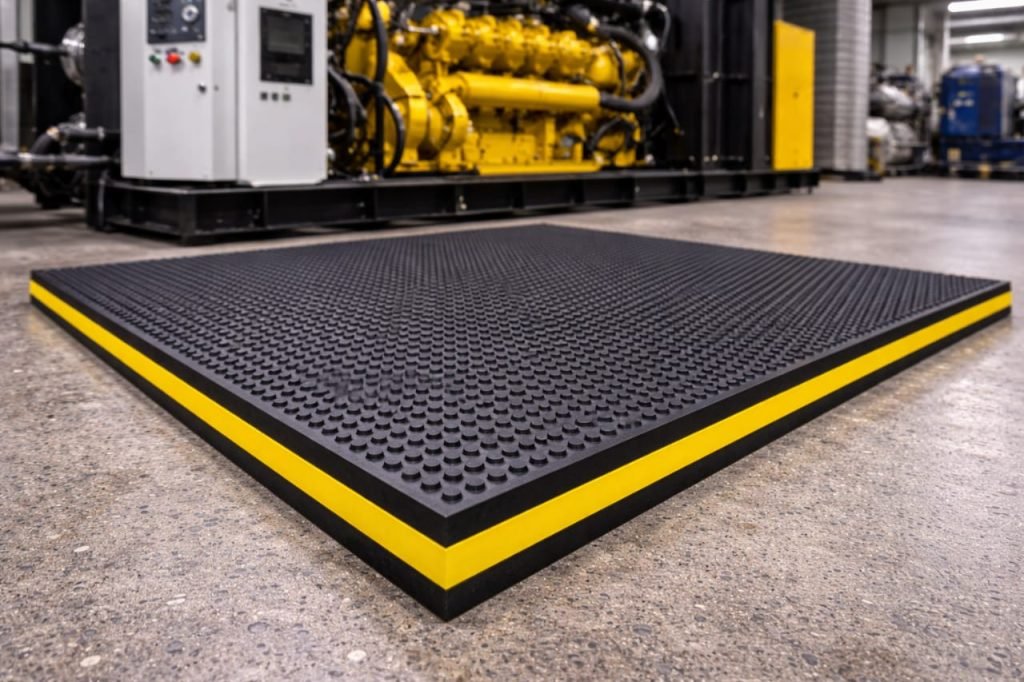
Rubber pads absorb vibration and shock under machinery, compressors, pumps, generators and HVAC plant, damping noise and protecting floors and foundations. Supplied plain, ribbed or waffle-profiled in thicknesses from 6 mm to 25 mm and hardnesses of 40 to 70 Shore A. Correct sizing matters: a pad that is too hard or too lightly loaded can amplify vibration rather than isolate it, so send us the machine weight, the number of mounting points and the running speed.
Anti-vibration mounting for machinery, pumps & compressors
Ribbed / waffle profile deflects far better than plain rubber
A rubber pad is placed under machinery, compressors, pumps, generators and structures to absorb vibration and shock, damp noise, spread load and protect the floor or foundation underneath. It is the simplest and cheapest form of vibration isolation, and where it suits the duty it works extremely well.
But there is one thing about anti-vibration pads that is very often left unsaid, and it is the difference between a mount that works and one that makes things worse. Isolation only occurs when the machine runs well above the natural frequency of the mount. The rule of thumb is that the forcing frequency must be at least about 1.4× the natural frequency of the pad-and-machine system. If it is not — if the pad is too hard, too thin, or barely loaded — you land near resonance and the pad amplifies the vibration instead of isolating it. This is why “it got worse after we fitted the pads” is a real and entirely explicable complaint, not a nonsense one. Getting the pad to deflect properly under the actual machine weight is the whole job.
That single fact explains most of what follows. It is why ribbed and waffle profiles exist: rubber is essentially incompressible, so a plain flat pad squeezed between two rigid faces has nowhere to go and barely deflects at all — the ribs give it somewhere to bulge into, so it can actually work as a spring. It is why hardness and thickness must be matched to the load rather than picked for durability. And it is why, below roughly 1200 rpm, rubber is usually the wrong product and a spring isolator is the right one. Tell us the machine weight, the number of mounting points and the running speed, and we will tell you what will actually work.
Specifications
Typical properties for industrial anti-vibration rubber pads. The correct hardness and thickness depend on the load per pad and the running speed of the machine — send us those two figures rather than ordering on thickness alone.
Property
Value
Test Standard
Material
Natural rubber / SBR (standard); NBR or EPDM to order
—
Hardness
40 – 70 Shore A (50–60 typical)
ASTM D2240
Thickness
6 mm – 25 mm
—
Profile
Plain, ribbed or waffle
—
Typical Load Range
~0.3 – 0.8 N/mm² (MPa)
—
Typical Static Deflection
~1 – 3 mm under correct load
—
Natural Frequency
≈ 15.76 ÷ √(deflection in mm) Hz
—
Effective Isolation Above
~1200 rpm (below this, use springs)
—
Isolation Begins When
Forcing frequency > ~1.4 × natural frequency
—
Temperature (NR / SBR)
−40°C to +80°C
—
Temperature (NBR — oily areas)
−30°C to +100°C
—
Temperature (EPDM — outdoors)
−45°C to +150°C
—
Oil Resistance
Poor in NR/SBR — specify NBR for oily plant rooms
—
Ozone / UV Resistance
Poor in NR/SBR — specify EPDM outdoors
—
Abrasion Resistance
Excellent (natural rubber)
—
Compression Set
Expect some permanent set over years under load
—
Supply Form
Cut pads, strips, or sheet to be cut on site
—
Properties in Detail
Vibration Isolation
Isolation Condition
Forcing freq > ~1.4 × natural freq
Below That Ratio
Amplifies vibration — worse than no pad
Natural Frequency
≈ 15.76 ÷ √(static deflection, mm) Hz
Effective Above
~1200 rpm
Below 1200 rpm
Use spring isolators — rubber will not do it
Why Ribbed / Waffle
Rubber is incompressible — ribs give it room to bulge
Physical Properties
Hardness
40 – 70 Shore A (50–60 typical)
Thickness
6 mm – 25 mm
Typical Load
~0.3 – 0.8 N/mm²
Static Deflection
~1 – 3 mm under correct load
Compression Set
Some permanent set over years — inspect periodically
Grade Selection
Standard (dry indoor)
Natural rubber / SBR
Oily Plant Rooms
NBR — oil destroys NR/SBR
Outdoor / Rooftop
EPDM — ozone and UV crack NR/SBR
High Temperature
EPDM to 150°C
Manufacturing
Rubber pads are produced by compounding and vulcanising an elastomer into a sheet or moulded profile of controlled thickness and hardness. The base polymer sets the environmental resistance — natural rubber and SBR for standard dry indoor duty, NBR where oil is present, EPDM where the pad lives outdoors — while the hardness and profile set its mechanical behaviour under load.
The profile is not decoration, and it is worth understanding why. Rubber is very nearly incompressible: it changes shape but it does not meaningfully change volume. A plain flat pad clamped between a machine base and a concrete floor is constrained on both faces, has nowhere to bulge outward to, and therefore barely deflects at all — which means it barely isolates. Ribbed and waffle profiles deliberately remove material to create free surfaces, giving the rubber somewhere to deform into. The pad can then actually deflect under the machine weight, achieve a low natural frequency, and behave as the soft spring that vibration isolation requires. That is why a ribbed pad outperforms a plain pad of the same rubber and the same thickness.
Thicknesses & Options
Thicker pads deflect more and isolate better — but only if they are loaded enough to actually compress. An unloaded thick pad is a hard pad. Send us the machine weight and the number of mounting points and we will size it properly.
Thickness
Typical Use
Availability
6 mm
Light machinery, appliance and equipment feet
Stock
8 mm
Small pumps, light machine mounts
Stock
10 mm
General machine mounting — the common size
Stock
12 mm
Pumps, motors, compressors
Stock
15 mm
Heavier machinery, generator sets
Stock
20 mm
Heavy machinery, structural bearing pads
To order
25 mm
Heavy duty, maximum deflection
To order
Available plain, ribbed or waffle-profiled. Supplied as cut pads to your dimensions, as strips, or as sheet for cutting on site. For general matting and lining rather than machine mounting, see our Rubber Sheet.
Chemical Resistance
Standard anti-vibration pads are natural rubber or SBR, which are excellent mechanically but have poor oil resistance and poor ozone resistance. That matters more than it sounds: compressor and plant rooms very often have oil on the floor, and rooftop HVAC plant sits in full sun. In those two situations the standard grade will degrade, and the grade must change — NBR for oil, EPDM for outdoors. Tell us where the pad is going.
Medium
Resistance
Notes
Dry Indoor Plant Floor
Excellent
Standard natural rubber / SBR is ideal
Vibration & Shock Absorption
Excellent
The job the pad exists to do
Abrasion & Impact
Excellent
Natural rubber is outstanding here
Oil on the Floor (compressor rooms)
Poor
NR/SBR degrades — specify NBR instead
Outdoor / Rooftop / UV Exposure
Poor
NR/SBR cracks — specify EPDM instead
Steam & Hot Water
Fair
EPDM grade only
Acids & Alkalis
Fair
EPDM grade; tell us the chemical
High Temperature (>80°C)
Fair
EPDM to 150°C; NR/SBR will not survive
Low-Frequency Machinery (<1200 rpm)
Poor
Wrong product — use spring isolators
General guidance for the material family at normal industrial concentrations. See the full Chemical Compatibility Chart, and confirm your exact chemical, concentration and temperature with us before final selection.
Applications
Anywhere a machine shakes, and that shaking is reaching something it should not.
Machine & Motor MountsThe core application. Pads under machine feet decouple the equipment from the floor so vibration is absorbed in the rubber rather than transmitted into the structure — and so the machine does not walk across the floor.
Compressor & Pump MountingReciprocating compressors and pumps are among the worst vibration sources in a plant. Note that compressor rooms usually have oil on the floor, so specify NBR here — standard natural rubber will degrade.
HVAC Plant & Rooftop UnitsAir handling units, chillers and fans mounted on pads to stop vibration and noise carrying into the building structure. Rooftop plant sits in UV and ozone, so EPDM is the correct grade outdoors.
Generator SetsGensets transmit heavy vibration into the slab and into the building. Pads under the skid absorb it — but check the running speed, because a slow-running set may need springs rather than rubber.
Structural & Bearing PadsLoad-spreading and bearing pads between structural members, distributing load and accommodating small movements without point-loading the concrete.
Glass Separator & Protection PadsCut pads used to separate and cushion glass, plate and finished goods in handling and transit, protecting the surface from impact and abrasion damage.
Industries
Why Rubber Pad is specified in each of the industries we serve.
Manufacturing & Engineering Workshops
Every workshop has machines that shake, and rubber pads under the feet are the cheapest way to stop that vibration reaching the floor, the neighbouring machines and the people working around them. Presses, compressors, lathes, grinders and pumps all benefit, and the pads also stop equipment slowly walking across the slab. The one thing worth being deliberate about is the grade: machine shops and compressor rooms usually have oil on the floor, and standard natural rubber and SBR degrade in oil. Specifying NBR for those areas costs very little more and avoids a pad that has gone soft and greasy within a year. The other check is running speed — rubber pads isolate well above roughly 1200 rpm, and below that you should be talking to us about spring isolators instead.
HVAC & Building Services
In building services, vibration is really a noise problem: an air handling unit or chiller that transmits vibration into the structure will be heard two floors away, and in an occupied building that is a complaint rather than a maintenance issue. Rubber pads under AHUs, chillers, fans and pumps break that structural path, and for typical fan and pump speeds they are very effective. Two things decide whether they work. Rooftop and plant-deck equipment sits in sun and ozone, so EPDM should be specified rather than standard natural rubber, which will crack. And the pad must be correctly loaded to deflect — a lightly loaded, over-hard pad sits near resonance and can make the transmitted noise worse rather than better, which is the usual explanation when isolation is fitted and nothing improves.
Power Plants
Power generation puts heavy, continuously running rotating equipment on concrete, and the vibration transmitted into foundations and structures is both a structural fatigue concern and a serious noise source. Rubber pads under pumps, fans, motors and auxiliary skids absorb that energy before it reaches the slab. The critical engineering check in this industry is the running speed of the machine relative to the natural frequency of the mount, because a large slow-turning machine is exactly the case where rubber pads are the wrong answer: below around 1200 rpm they do not isolate effectively, and a spring isolator is required instead. We would rather tell you that up front than sell you pads that will not solve the problem. Send us the machine weight, the mounting-point count and the running speed and we will tell you honestly which product you need.
Construction
On site, rubber pads do two distinct jobs and both are load-related rather than vibration-related. As structural bearing pads they sit between members to spread load, accommodate small differential movements and prevent hard point-loading of concrete, which is where cracking begins. As protection and separator pads they cushion glass, panels, plate and finished goods during handling and transit, where natural rubber’s excellent abrasion and impact resistance is exactly the right property. For anything permanently exposed on a facade, roof or external structure, specify EPDM rather than natural rubber, since ozone and UV will progressively crack a standard pad that spends its life outdoors.
Rubber Pad vs Other Isolation Options
The honest summary: rubber pads are excellent above roughly 1200 rpm and poor below it. If your machine is slow-turning, springs are the right product and we will say so.
Property
Rubber Pad
Rubber Sheet (cut)
Spring Isolator
Cork / Composite
Bolted Direct
Vibration Isolation
Good (above ~1200 rpm)
Fair
Excellent at low frequency
Fair
None
Low-Speed Machinery
Poor — use springs
Poor
Excellent
Poor
None
Static Deflection
~1 – 3 mm
Low
10 – 50 mm
Low
Zero
Noise Damping
Good
Fair
Fair (needs a pad too)
Good
None
Shock & Impact
Excellent
Good
Fair
Fair
None
Load Spreading
Excellent
Good
Point load
Good
Point load
Oil Resistance
NBR grade only
NBR grade only
Excellent (steel)
Poor
—
Cost
Low
Lowest
High
Low
None
Choose It For
Machine mounts above ~1200 rpm
Matting, general cushioning
Slow, heavy machinery
Light static loads
Nothing that vibrates
Advantages & Limitations
Advantages
Simple, cheap and immediately effective vibration and noise isolation for machinery running above roughly 1200 rpm.
Excellent shock and impact absorption — natural rubber is outstanding in this respect.
Spreads load and protects floors, foundations and concrete from point-loading and cracking.
Ribbed and waffle profiles deflect far better than plain rubber of the same thickness, giving genuinely useful isolation.
Stops machines walking across the floor and reduces fastener loosening from transmitted vibration.
Available in NBR for oily plant rooms and EPDM for outdoor and rooftop duty, so the grade can be matched to the environment.
Limitations
A badly sized pad amplifies vibration instead of isolating it. Isolation only begins when the forcing frequency exceeds about 1.4× the natural frequency of the mount. Too hard, too thin or too lightly loaded, and you sit near resonance and make the problem worse. This is the single most important thing to get right.
Poor low-frequency isolation. Below roughly 1200 rpm, rubber pads do not work well and spring isolators are the correct product. We will tell you if that is your situation.
A plain pad barely deflects. Rubber is essentially incompressible, so a flat pad clamped between two rigid faces has nowhere to bulge and acts almost rigid. Use a ribbed or waffle profile where isolation actually matters.
Standard natural rubber and SBR have poor oil resistance — a real problem in compressor rooms and machine shops, where NBR should be specified instead.
Standard grades also have poor ozone and UV resistance and will crack outdoors — specify EPDM for rooftop and external duty.
Rubber takes a compression set over years under sustained load, gradually losing deflection and therefore isolation. Inspect periodically rather than fitting and forgetting.
Installation, Storage & Maintenance
Installation
Get the load right before anything else: the pad must be loaded enough to actually deflect, because an under-loaded pad is a hard pad and a hard pad does not isolate. Work out the load per mounting point (machine weight divided by the number of pads) and size the pad area and hardness to that figure, not to the size of the machine foot. Ensure the floor is flat and clean so the load is spread evenly across the pad rather than concentrated on one edge. Where the machine is bolted down, use rubber bushes or grommets on the bolts as well — a rigid bolt straight through the pad into the slab short-circuits the isolation completely and is one of the most common reasons a correctly chosen pad delivers nothing. Do not over-compress the pad; a rubber pad crushed solid has no spring left in it. Check the running speed is comfortably above the natural frequency of the mount.
Storage
Store flat, in a cool, dry, dark place, and not under load — storing pads under a heavy stack sets a permanent compression into them before they ever reach the machine, which is exactly the deflection you are paying for. Keep them out of direct sunlight and away from electric motors, which generate ozone; ozone attacks rubber in storage just as it does in service. Keep them away from oil unless they are NBR grade.
Maintenance
Inspect pads periodically rather than fitting and forgetting them. The failure to look for is compression set: over years under sustained load, rubber gradually takes a permanent deformation, the static deflection falls, the natural frequency of the mount rises, and the isolation quietly degrades — often to the point where the machine is close to resonance again. A pad that has visibly flattened, hardened or lost its rib profile has stopped doing its job and should be replaced. Also check for oil contamination (a soft, swollen, greasy pad means the wrong grade for an oily floor) and surface crazing (ozone and UV attack, meaning the wrong grade for an outdoor location). And if a machine starts vibrating more than it used to, check the hold-down bolts have not been over-tightened straight through the pad, which removes the isolation entirely.
Buying Guide
What to tell us so we quote the right grade first time.
Machine weight, and the number of mounting points. These two figures give the load per pad, which is what actually determines the correct pad size and hardness. Ordering on thickness alone is guesswork.
Running speed of the machine (rpm). The most important question, and the one most often skipped. Above roughly 1200 rpm, rubber pads work well. Below it, they will not isolate properly and you need spring isolators — we would rather tell you that than sell you pads that disappoint.
Where is the pad going — dry floor, oily plant room, or outdoors? This sets the grade. Dry indoor → natural rubber/SBR. Oil present → NBR. Outdoors or rooftop → EPDM. Standard grades fail in oil and in UV.
Is the machine bolted down? If yes, you also need rubber bushes or grommets on the bolts. A rigid bolt through the pad into the slab bypasses the isolation completely and wastes the pad.
Plain, ribbed or waffle profile? If isolation genuinely matters, choose ribbed or waffle. Rubber is incompressible, so a plain clamped pad barely deflects and barely isolates.
Operating temperature. Natural rubber and SBR run to about 80°C. Above that you need EPDM, which goes to around 150°C.
Is this vibration isolation, or load spreading? They are different problems with different answers. Load spreading and bearing duty is far less fussy about frequency; vibration isolation lives or dies on it.
Standards & Compliance
Hardness measured to ASTM D2240 (Shore A durometer).
Supplied in commercial thicknesses from 6 mm to 25 mm, plain, ribbed or waffle-profiled.
Natural rubber / SBR standard; NBR (oil-resistant) and EPDM (weather-resistant) grades available to order.
Natural frequency of a rubber mount is approximated by fn ≈ 15.76 ÷ √δ, where δ is the static deflection in mm — the basis of the isolation check described above.
Certificates of conformity available on request — tell us at the point of order if you need documentation.
Anti-vibration mounting and load cushioning — under machinery, compressors, pumps, generators, HVAC plant and structures. It absorbs vibration and shock, damps noise, spreads load and protects the floor or foundation underneath.
Can a rubber pad make vibration worse?
Yes, and this is the single most important thing to understand about anti-vibration pads. Isolation only happens when the machine’s forcing frequency is at least about 1.4× the natural frequency of the mount. If the pad is too hard, too thin or too lightly loaded, you end up near resonance and the pad amplifies the vibration instead of isolating it. “It got worse after we fitted pads” is a real and explicable outcome, not a nonsense one.
How do I know if a rubber pad will work for my machine?
Check the running speed. Rubber pads isolate effectively above roughly 1200 rpm. Below that, they generally will not, and you need spring isolators instead. Send us the machine weight, the number of mounting points and the running speed, and we will tell you honestly which product you need — including telling you if it is not this one.
Why are rubber pads ribbed or waffle-profiled?
Because rubber is essentially incompressible — it changes shape but not volume. A plain flat pad clamped between a machine base and a concrete floor has nowhere to bulge outward to, so it barely deflects and therefore barely isolates. Ribs and waffles create free surfaces the rubber can deform into, so the pad can actually work as a soft spring. A ribbed pad substantially outperforms a plain pad of the same rubber and the same thickness.
What thickness rubber pad do I need?
10 mm is the common general machine-mounting size, with 6–8 mm for light equipment and 15–25 mm for heavy machinery. But thickness alone is not the right way to order: a thick pad that is not loaded enough to compress behaves like a hard pad. Send us the machine weight and the mounting-point count.
What hardness should I choose?
50–60 Shore A is typical. Softer rubber deflects more, which lowers the natural frequency and improves isolation, but it carries less load. Harder rubber carries more load but deflects less and isolates worse. The correct hardness is the one that gives proper deflection under your actual load, which is why we ask for the weight.
Do I still need rubber pads if the machine is bolted down?
Yes — but you also need rubber bushes or grommets on the bolts. A rigid bolt passing straight through the pad into the slab short-circuits the isolation entirely, and the pad then does almost nothing. This is one of the most common reasons a correctly chosen pad delivers no improvement.
Can I use a rubber pad in a compressor room with oil on the floor?
Not the standard grade. Natural rubber and SBR have poor oil resistance and will soften and degrade. Specify NBR (Nitrile) for oily plant rooms — it costs slightly more and lasts enormously longer in that environment.
Can rubber pads be used outdoors or on a rooftop?
Only in the right grade. Natural rubber and SBR have poor ozone and UV resistance and will crack in sunlight. Specify EPDM for rooftop, external and exposed applications.
What is the maximum temperature for a rubber pad?
Standard natural rubber and SBR run to about 80°C. NBR handles about 100°C. EPDM goes to around 150°C and is the grade to specify for hot locations.
What load can a rubber pad take?
Typically around 0.3 to 0.8 N/mm² (MPa), depending on grade and hardness. Divide the machine weight by the number of mounting points to get the load per pad, then size the pad area to sit in that range. We will do this for you if you send the figures.
What is static deflection and why does it matter?
It is how far the pad compresses under the machine weight, and it is what determines the natural frequency of the mount — approximately 15.76 divided by the square root of the deflection in millimetres, in Hz. That natural frequency is what decides whether you get isolation or amplification, so deflection is really the whole design variable.
What is the difference between a rubber pad and rubber sheet?
Function and profile. Rubber sheet is a general-purpose material cut into gaskets, linings and matting. A rubber pad is specifically for machine mounting and load cushioning, and is available ribbed or waffle-profiled so it deflects properly under load. You can cut pads from sheet, but a plain sheet pad will isolate noticeably less well than a profiled one.
Why is my old rubber pad flat and hard?
Compression set. Over years under sustained load, rubber takes a permanent deformation. The deflection falls, the natural frequency of the mount rises, and the isolation quietly degrades — sometimes to the point where the machine is back near resonance. A visibly flattened or hardened pad has stopped doing its job and should be replaced.
Will rubber pads stop my machine from moving across the floor?
Yes, that is one of their useful secondary jobs. The friction and damping stop equipment walking under its own vibration, which also reduces the fastener loosening that comes with it.
Can rubber pads be used as structural bearing pads?
Yes. Spreading load between structural members, accommodating small differential movements and preventing hard point-loading of concrete is a well-established use. Bearing duty is far less fussy about frequency than vibration isolation is, so the selection is simpler.
What grade of rubber pad is standard?
Natural rubber or SBR, which are excellent mechanically and give outstanding abrasion and impact resistance at low cost. Change grade when the environment demands it: NBR if there is oil, EPDM if it is outdoors or hot.
How should rubber pads be stored?
Flat, cool, dry, dark — and not under load. Storing pads under a heavy stack sets a permanent compression into them before they are ever fitted, destroying the very deflection you bought them for. Keep them out of sunlight and away from electric motors, which produce ozone.
Do you supply pads cut to size?
Yes. We supply cut pads to your dimensions, strips, or sheet for cutting on site. Tell us the size and quantity, or send a drawing.
My machine is slow-running. Should I still buy rubber pads?
Probably not, and we would rather say so. Below roughly 1200 rpm rubber pads do not isolate effectively, and you may get little benefit or even amplification. Spring isolators are the correct product for slow, heavy machinery. Tell us the speed and weight and we will give you a straight answer.
Need a quote or a spec check?
Send us your operating conditions and we will confirm the right grade for the job.