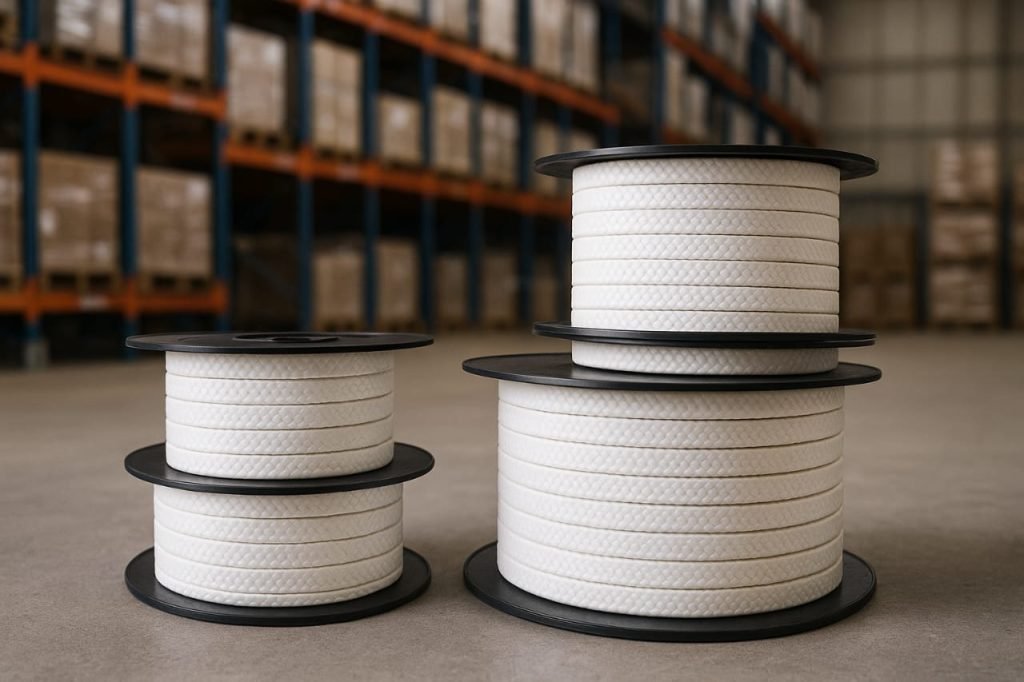
Pure PTFE packing is made up of 100% pure PTFE fiber and has a Ph range of 0-14.It can also withstand continuous temperatures of 260c.It has a high chemical resistance and very low coefficients of friction.It can be used on all acids except the strong oxidizing ones.It is suitable for valves and pumps used in food processing,Pharmaceuticals,Paper mills and fiber plant where high purity and corrosion resistance is required.It is available in square shape and the sizes available range from 3mm to 25mm.
Full pH 0–14 chemical resistance — near-universal
Clean, non-contaminating white PTFE for food & pharma duty
Lowest coefficient of friction of any packing material
Pure PTFE gland packing is braided from 100% virgin PTFE yarn. It is chosen for one reason above all others: chemistry. PTFE is inert to very nearly everything, so this packing handles the full pH 0–14 range — strong acids, strong alkalis, solvents, and aggressive process media that would destroy any fibre-based packing. Where the media is the problem, this is the answer.
Its second job is purity. Virgin white PTFE does not contaminate, discolour or taint the product passing through the pump, which is why it is the standard packing for food, dairy, beverage and pharmaceutical duty. It also has the lowest coefficient of friction of any packing material, which means it is gentle on shafts and sleeves — a genuine advantage on expensive, hard-to-replace equipment.
What pure PTFE is not is a slurry packing, and it is not a high-speed dry-running packing. Its abrasion resistance is only fair — on gritty or abrasive service it wears out where aramid packing would last. And PTFE has low thermal conductivity: unlike graphite, it does not conduct frictional heat away from the shaft. Run it dry at speed and heat builds up at the packing face rather than escaping. That single property drives most of the installation rules below.
Specifications
Typical properties for 100% virgin PTFE braided packing. Limits vary by grade and by whether the duty is rotary, reciprocating or a valve stem — confirm against your application.
Property
Value
Test Standard
Material
100% virgin PTFE yarn, braided
—
Construction
Interlock / square braid
—
Colour
White (virgin PTFE)
—
Max Temperature
260°C continuous
—
Min Temperature
−200°C (cryogenic capable)
—
pH Range
0 – 14 (full range)
—
Coefficient of Friction
~0.04 – 0.10 — the lowest of any packing
—
Max Shaft Speed
~15 m/s
—
Max Pressure — Rotary Pumps
~20 bar
—
Max Pressure — Valves
up to ~100 bar
—
Thermal Conductivity
Low (~0.25 W/m·K) — does NOT carry heat away from the shaft
—
Abrasion Resistance
Fair — not a slurry packing
—
Extrusion Resistance
Fair — consider aramid end rings at pressure
—
Cold Flow / Creep
Yes — re-tighten the gland after bedding in
—
Shaft Wear Risk
Very low — the gentlest packing on a shaft
—
Food / FDA Compliance
Virgin white PTFE grades available
—
Standard Sizes
3 mm – 25 mm square section
—
Supply Form
Coil / spool by weight, or pre-cut rings
—
Properties in Detail
Chemical & Purity
pH Range
0 – 14 (full range)
Acid Resistance
Excellent — including strong acids
Alkali Resistance
Excellent — including strong alkalis
Solvent Resistance
Excellent
Food / Pharma Use
Yes — virgin white PTFE, non-contaminating
Thermal Properties
Max Temperature
260°C continuous
Min Temperature
−200°C
Thermal Conductivity
Low — will not cool the shaft; do not run dry
Steam Suitability
Limited — graphite is the correct steam packing
Mechanical Properties
Coefficient of Friction
~0.04 – 0.10 (lowest available)
Max Shaft Speed
~15 m/s
Abrasion Resistance
Fair — not for slurry
Extrusion Resistance
Fair — aramid end rings help at pressure
Cold Flow
Yes — requires re-tightening after run-in
Manufacturing
Pure PTFE packing is produced by interlock-braiding continuous virgin PTFE yarn into a dense square section. The interlock braid locks every strand into the structure so the packing holds its shape under gland load instead of unravelling or squeezing out through the clearance. A break-in lubricant is normally worked into the braid so the packing does not run dry during the critical first hours of service.
Because the yarn is 100% virgin PTFE with no fillers, dyes or reinforcing fibre, the finished packing carries PTFE chemistry all the way through — which is exactly what gives it the full pH 0–14 range and its clean, non-contaminating behaviour in food and pharmaceutical service. It is also what makes it soft: there is no hard fibre in the braid to resist abrasion or extrusion, which is the trade-off for that chemical performance.
Sizes & Availability
Supplied in standard square cross-sections. Your size is set by the stuffing box: packing size = (bore − shaft diameter) ÷ 2. Our Gland Packing Calculator works out the size, ring length and total metres for you.
Section Size
Typical Use
Availability
3 mm
Instrument valves, small dosing pumps
Stock
4 mm
Small chemical pumps
Stock
5 mm
Small / medium process pumps
Stock
6 mm
Medium process pumps, valve stems
Stock
8 mm
Medium process pumps
Stock
9.5 mm
Process & chemical pumps
Stock
10 mm
Process & chemical pumps
Stock
12 mm
Large process pumps, agitators
Stock
14 mm
Large pumps, agitators, mixers
Stock
16 mm
Large pumps, agitators, mixers
Stock
19 mm
Heavy duty
Stock
20 mm
Heavy duty
Stock
22 mm
Heavy duty
To order
25 mm
Heavy duty
To order
Supplied by weight on coils/spools, or as pre-cut rings made to your shaft and bore dimensions. Tell us shaft diameter, stuffing box bore and number of rings and we will supply exactly what fits.
Chemical Resistance
PTFE is one of the most chemically inert materials in industrial use — this is the reason to buy this packing. It resists effectively the entire pH range. The very short list of exceptions is genuine but exotic: molten alkali metals, elemental fluorine and chlorine trifluoride. If you are running any of those, tell us and we will discuss it properly.
Medium
Resistance
Notes
Strong Acids (sulphuric, nitric, hydrochloric)
Excellent
The application this packing exists for
Strong Alkalis (caustic soda, KOH)
Excellent
Full resistance across the alkaline range
Solvents & Ketones
Excellent
Inert to effectively all common solvents
Food, Dairy & Beverage
Excellent
Virgin white PTFE — clean and non-contaminating
Pharmaceutical Media
Excellent
Non-reactive, non-shedding, no product taint
Hydrocarbons & Fuels
Excellent
Fully resistant
Chlorine & Oxidizers
Good
Resistant — far better than aramid or cotton
Steam
Fair
Within its 260°C limit, but graphite is the proper steam packing
Abrasive Slurry
Poor
Wrong material — use aramid packing for abrasion
Molten Alkali Metals / Fluorine
Poor
One of the few genuine exceptions for PTFE
General guidance for the material family at normal industrial concentrations. See the full Chemical Compatibility Chart, and confirm your exact chemical, concentration and temperature with us before final selection.
Applications
Pure PTFE packing goes wherever the media is aggressive, or the product must stay clean.
Chemical & Acid Process PumpsThe core application. Pumps handling strong acids, caustics and solvents destroy fibre-based packing chemically rather than mechanically. Pure PTFE is inert across pH 0–14 and simply does not care what is passing through.
Food, Dairy & Beverage EquipmentVirgin white PTFE is clean and non-contaminating, so it will not taint, discolour or shed into the product. It is the standard packing where the pumped fluid ends up being eaten or drunk.
Pharmaceutical & Hygienic DutyNon-reactive, non-shedding and cleanable. Pure PTFE packing meets the purity expectations of pharmaceutical process equipment where any risk of product contamination is unacceptable.
Chemical Dosing Pumps & Valve StemsDosing lines carry concentrated chemistry at low flow. PTFE packing handles the media, and its very low friction means valve stems and small shafts move freely without binding.
Cryogenic ServicePTFE stays flexible and functional down to around −200°C, so the same packing that handles hot acid also seals cryogenic duty — a range almost no other packing material covers.
Shaft-Sensitive EquipmentPTFE has the lowest coefficient of friction of any packing material and is the gentlest on a shaft or sleeve. Where the shaft is expensive, hard to replace, or already showing wear, PTFE protects it where a harder packing would score it.
Industries
Why Pure PTFE Gland Packing is specified in each of the industries we serve.
Chemical Plants
A chemical plant is where packing selection is decided by the media and almost nothing else. Pumps and valves handling sulphuric or hydrochloric acid, caustic soda, solvents and ketones will chemically consume cotton, jute and even aramid packing regardless of how well those materials handle pressure or abrasion. Pure PTFE gland packing sidesteps the problem entirely: it is inert across the full pH 0–14 range, so the aggressiveness of the process fluid stops being the variable that governs packing life. That is why it is the default across acid dosing, caustic transfer and solvent handling lines. The two things worth checking before you standardise on it are temperature, since 260°C is a real ceiling, and abrasion — if the stream carries solids, PTFE is the wrong choice and aramid should be considered instead.
Food & Beverage Processing
In food and beverage production the packing is not just a sealing component, it is a product-contact material, and that changes the specification completely. A packing that sheds fibre, leaches lubricant, discolours or imparts taste is a contamination risk long before it is a leak risk. Virgin white PTFE gland packing is chosen precisely because it does none of those things: it is chemically inert, non-shedding and does not taint the product passing through the pump. It also stands up to the caustic and acidic clean-in-place cycles that hygienic lines are washed down with, which is where many otherwise-adequate packings quietly degrade. For dairy, juice, edible oil and beverage pumps it is the correct default, and food-grade documentation is available on request when your auditor asks for it.
Pharmaceutical Manufacturing
Pharmaceutical manufacturing applies the strictest purity requirements of any industry we supply, and the sealing components are inside that boundary. Any packing that could shed particulate, react with the process fluid or introduce an extractable into the batch is unacceptable, irrespective of how well it seals. Pure PTFE gland packing is specified because it is non-reactive, non-shedding and cleanable, and because virgin PTFE chemistry is well characterised and widely accepted in regulated environments. It handles the aggressive solvents used in synthesis as readily as it handles the purified water systems on the utility side. As with food duty, tell us at the point of order if you need conformity documentation — supplying the right material without the paperwork to prove it is of limited use in a validated plant.
Paper Mills
A paper mill needs different packings in different places, and treating it as a single sealing problem is what causes premature failures. On the bleaching and chemical recovery side the media is genuinely aggressive — chlorine dioxide, peroxide, caustic and acid — and pure PTFE packing is the right material there, precisely because those chemicals do not touch it. On the wet stock side, however, the problem is completely different: pulp carries fibre and grit, and the failure mode is abrasion, not chemistry. PTFE will wear out on stock pumps where aramid packing would last. Matching each line to its actual failure mode — chemistry to PTFE, abrasion to aramid, steam to graphite — is what keeps the whole mill reliable.
Pure PTFE vs Other Gland Packings
Pick on the dominant problem: chemistry, heat, or abrasion. Pure PTFE wins on chemistry and purity — and loses on abrasion.
Property
Pure PTFE
Graphite
Aramid
Cotton / Jute
Max Temperature
260°C
450°C (650°C valves)
250 – 260°C
~100°C
Min Temperature
−200°C
−200°C
−100°C
~0°C
Chemical Resistance
Excellent (pH 0–14)
Excellent
Fair (pH 2–12)
Poor
Abrasion Resistance
Fair
Fair
Excellent
Poor
Food / Pharma Safe
Yes — the standard
No (marks product)
No
No
Coefficient of Friction
Lowest available
Very low
Moderate
Moderate
Heat Conducted Away
Poor — do not run dry
Excellent
Low
Low
Shaft Wear Risk
Very low
Low
Higher — hard fibre
Low
Steam Service
Limited
Yes — the standard
No
No
Relative Cost
Medium–High
Medium
High
Low
Choose It For
Chemicals, food, pharma, any pH
Steam & high heat
Slurry & abrasion
Plain water, low cost
Advantages & Limitations
Advantages
Full pH 0–14 chemical resistance — handles strong acids and strong alkalis alike.
Clean, non-contaminating virgin white PTFE — suitable for food, dairy and pharmaceutical product contact.
The lowest coefficient of friction of any packing material — very gentle on shafts and sleeves.
Extremely wide temperature span: cryogenic −200°C up to 260°C.
Does not harden, embrittle or degrade chemically in service.
Excellent choice for valve stems, where low friction keeps the stem moving freely.
Limitations
Low thermal conductivity. Unlike graphite, PTFE does not carry frictional heat away from the shaft. Never run it dry at speed — allow the controlled drip, and use a flush or lantern ring where the duty calls for one.
It cold-flows (creeps). PTFE relaxes under sustained load, so the gland will need re-tightening after bedding in. Budget for that check rather than treating the first leak as a failure.
Only fair abrasion resistance. Wrong material for slurry, pulp stock or gritty water — use aramid packing there.
Only fair extrusion resistance at pressure — aramid end rings around a PTFE core are a very effective combination.
Not the right packing for steam and high-temperature boiler service — that is graphite territory.
More expensive per metre than cotton or jute — justify it on chemistry or purity, not as a general-purpose upgrade.
Installation, Storage & Maintenance
Installation
Cut rings squarely on a mandrel of the correct shaft diameter — never spiral-wind a continuous length into the box. Fit one ring at a time, seating each fully before adding the next, and stagger the joints of successive rings by 90° or 120° so there is no straight leak path. Tighten the gland nuts finger-tight plus a small amount only. Two things are specific to PTFE and matter more than with other packings: never run it dry — PTFE does not conduct frictional heat away from the shaft, so an over-tightened, bone-dry gland overheats fast; and come back and re-tighten it after it beds in, because PTFE cold-flows and the gland load will relax. See our step-by-step gland packing installation guide.
Storage
Store coils and spools in a clean, dry place in the original wrapping, away from dust and contamination — particularly important for food and pharmaceutical grades, where the packing is a product-contact material and should reach the equipment clean. PTFE is chemically stable and does not degrade with age or UV, so shelf life is not a practical concern.
Maintenance
Expect to re-tighten the gland after the packing beds in: PTFE cold-flows, and the initial gland load will relax over the first hours or days of service. This is normal behaviour, not a defect. Beyond that, maintain a slight, controlled drip — a completely dry gland on PTFE packing is actively dangerous because the material cannot conduct the resulting frictional heat away from the shaft. Inspect shaft and sleeve condition at every repack; PTFE is the gentlest packing on a shaft, so if you are finding shaft wear, the cause is elsewhere and worth investigating.
Buying Guide
What to tell us so we quote the right grade first time.
Shaft diameter and stuffing box bore. These set the packing section size: (bore − shaft) ÷ 2. Our Gland Packing Calculator works it out, plus the total metres you need.
What is the media, and what is its pH? This is the whole reason to buy PTFE packing. If the media is chemically benign and the real problem is grit or heat, a different packing will serve you better and cost less.
Is this a food, dairy or pharmaceutical application? Say so at the point of order. Virgin white food-grade PTFE is a specific grade, and if you need conformity documentation for an audit we need to know before we ship, not after.
Operating temperature. Confirm you are within the 260°C ceiling. Above that you need graphite packing.
Shaft speed, and is there a flush? PTFE cannot cool itself. At higher speeds tell us whether the stuffing box has a lantern ring and flush, because it changes what we recommend.
Does the stream carry any solids? If yes, pure PTFE is likely the wrong choice on its own. We may recommend aramid end rings with a PTFE core to get chemical resistance and extrusion resistance together.
Number of rings, and quantity of pumps. So we can supply the correct total length with a wastage allowance.
Standards & Compliance
Braided from 100% virgin PTFE yarn to standard commercial square cross-sections (3 mm to 25 mm).
Virgin white PTFE grades conform to the food-contact chemistry of FDA 21 CFR 177.1550 where food-grade duty is specified on the order.
Suitable for hygienic and pharmaceutical process equipment; state the requirement at point of order so the correct grade and documentation are supplied.
Certificates of conformity available on request — tell us at the point of order if you need documentation for an audit.
Chemically aggressive and hygienically sensitive service. Acid and caustic pumps, solvent handling, chemical dosing, and food, dairy, beverage and pharmaceutical equipment — anywhere the media would attack an ordinary packing, or where the product must not be contaminated.
What pH range can pure PTFE packing handle?
The full range, pH 0 to 14. PTFE is inert to effectively all common industrial chemistry, which is the main reason to specify it.
What is the maximum temperature for pure PTFE packing?
Around 260°C continuous. It also goes remarkably low — down to about −200°C — so it covers cryogenic duty as well, which almost no other packing does.
Can I use pure PTFE packing for steam?
Only within its 260°C limit, and even then it is not the ideal choice. Graphite gland packing is the correct material for steam and boiler-feed service; it handles far higher temperature and conducts heat away from the shaft, which PTFE does not.
Is pure PTFE packing food safe?
Virgin white PTFE grades are, and they are the standard packing for food, dairy and beverage pumps — clean, non-contaminating and non-shedding. Tell us at the point of order that it is a food application so the correct grade is supplied and any conformity documentation you need comes with it.
Why does my PTFE gland need re-tightening after a few days?
Because PTFE cold-flows. It relaxes under sustained gland load, so the initial load drops as the packing beds in. This is expected behaviour, not a fault. Plan a follow-up check and take the gland up gradually.
Can pure PTFE packing be run dry?
No — and this is the most important thing to know about it. PTFE has low thermal conductivity, so it does not carry frictional heat away from the shaft the way graphite does. A bone-dry, over-tightened PTFE gland overheats quickly. Maintain the slight controlled drip.
Will pure PTFE packing damage my shaft?
It is the least likely packing to. PTFE has the lowest coefficient of friction of any packing material and is the gentlest option on a shaft or sleeve. If you are seeing shaft wear with PTFE packing, the cause is almost certainly elsewhere — misalignment, a scored sleeve, or over-tightening.
Can I use pure PTFE packing on a slurry pump?
It is the wrong material. PTFE has only fair abrasion resistance and hard particulate will wear it out. Use aramid gland packing for abrasive duty. If the slurry is also chemically aggressive, talk to us — aramid end rings with a PTFE core is a common answer.
What pressure can pure PTFE packing handle?
Roughly 20 bar on rotary pumps and up to about 100 bar on valves. Its extrusion resistance is only fair, so at higher pressure aramid end rings around a PTFE core are worth considering.
What shaft speed can it handle?
Up to around 15 m/s. Bear in mind that speed generates frictional heat and PTFE cannot conduct that heat away, so at the top of the range a flush or lantern ring matters more than it would with graphite.
What size PTFE packing do I need?
Packing size = (stuffing box bore − shaft diameter) ÷ 2, rounded to the nearest standard section. Our Gland Packing Calculator does this for you and gives the total metres required.
How many rings do I need?
Typically 4 to 6, depending on the depth of the stuffing box. Count what came out, or send us the box dimensions and we will advise.
Should the gland drip?
Yes — a slight, controlled drip is correct and, with PTFE, genuinely necessary. It lubricates and cools the packing. A dry gland means it is over-tightened, and PTFE tolerates that worse than most materials because it cannot shed the heat.
Pure PTFE vs graphite packing — which do I need?
Ask what is killing the current packing. Aggressive chemistry, or a food/pharma purity requirement → pure PTFE. Steam and high heat → graphite. Graphite also conducts heat away from the shaft, which PTFE cannot; PTFE handles chemistry graphite cannot. They solve different problems.
Pure PTFE vs aramid packing — which do I need?
Chemistry or purity → pure PTFE. Abrasion and slurry → aramid. Aramid is a hard fibre built to survive grit; PTFE is a soft, inert material built to survive chemistry. Each is a poor substitute for the other.
Are there any chemicals PTFE cannot handle?
Very few, and they are exotic: molten alkali metals, elemental fluorine and chlorine trifluoride. For essentially all normal industrial chemistry, PTFE is inert. If you are running any of those three, tell us and we will discuss it properly.
What is the difference between pure PTFE and PTFE-impregnated packing?
Pure PTFE packing is braided from 100% PTFE yarn all the way through. PTFE-impregnated packing is another fibre (aramid, cotton, graphite) with PTFE worked into it. Impregnation improves lubricity and widens the chemical range, but only pure PTFE gives you the full inert PTFE chemistry and the clean, non-contaminating behaviour that food and pharmaceutical duty requires.
How is it supplied?
By weight on coils or spools, or as pre-cut rings made to your shaft and bore dimensions. Send us shaft diameter, box bore and ring count and we will supply exactly what fits.
How should I store it?
Clean and dry, in the original wrapping. PTFE is chemically stable and does not age or degrade in UV, so shelf life is not a concern — but for food and pharmaceutical grades keep it sealed and clean, because it is a product-contact material and should reach the pump uncontaminated.
Need a quote or a spec check?
Send us your operating conditions and we will confirm the right grade for the job.