
Industry Solutions
Steel Plants & FoundriesInsulation That Survives Furnace Temperatures
Reheat furnaces, expansion joints and hot ducting run at temperatures that eliminate almost every flexible insulation. We supply the ceramic fibre and heat-shielding materials that survive — and we specify them against your real continuous temperature, not a headline figure.
Industry Overview
Operating conditions & why material choice matters
Steel and foundry operations run at the top of the industrial temperature range. Reheat furnaces, ladles, holding furnaces and the expansion joints and ducting around them operate where only ceramic fibre products survive as a flexible insulation — glass wool and rock wool are eliminated outright by temperature.
On a furnace that is cycled with the production schedule, ceramic fibre’s very low heat storage becomes the dominant economic advantage. Unlike a brick lining, which has to be dragged up to temperature from cold on every cycle, a fibre lining stores very little energy — so the furnace reaches working temperature faster and burns measurably less fuel per cycle. Over a campaign this is a substantial, directly measurable saving.
The recurring specification error is buying on the classification figure. Ceramic fibre is sold at 1260 °C classification, which is a fibre test rating — not a promise of continuous service at that temperature. Realistic continuous use for that grade is around 1100 °C. Tell us your real continuous operating temperature and we will confirm the grade.
Common Engineering Challenges
What actually fails — and why
Each challenge links to the full technical article in our Resource Center.
Expansion Joints at Furnace Temperature
Joints near furnaces see continuous extreme heat. Ordinary insulation degrades and the joint becomes a heat path.
Read the guideFurnace Lining Degradation
Lining that still looks intact can have lost density from gas erosion and cycling — quietly costing fuel long before it visibly fails.
Read the guideMolten Metal Splash Exposure
Splash protection is a different requirement from heat resistance. Plain fibreglass cloth is not rated for direct molten contact.
Read the guideUnder-Specifying from Headline Numbers
Ceramic fibre’s 1260°C is a classification rating, not its continuous-use temperature (~1100°C).
Read the guideSolutions We Provide
Problem → material, with the reasoning
Every recommendation below links to the full technical page for that product.
Furnace lining & expansion joint insulation
Ceramic Fiber Wool
Classified to 1260°C with very low heat storage — the main fuel saving on a cycled furnace. Specify against your continuous temperature, not the classification figure.
Rigid hot face & gas erosion zones
Ceramic Board
Where blanket would erode in high-velocity gas, rigid board holds up. Often used as a hot face with blanket behind it.
Sealing & finishing insulation joints
Ceramic Fiber Tape
Seals and finishes the joints and edges of a ceramic fibre installation at the same temperature rating as the lining itself.
Gaps around burner ports & penetrations
Ceramic Paper
Compresses to fill irregular gaps and expansion joints without losing insulating value.
Molten metal splash protection
Vermiculite Coated Silica Cloth
Rated for splash and abrasion at ~1000°C continuous. Plain fibreglass cloth is not a splash material — this is the correct product for direct exposure.
General heat shielding & covers
Glass Cloth
Non-combustible heat shielding to ~550°C for covers, screens and protecting cables and hoses from radiant heat.
Engineering Case Studies
Real problems, real investigation, real outcomes
Each case is titled by the engineering problem it solved — not by the customer’s name.
Customer Problem
Expansion joints near the furnaces at Mughal Steel, Sheikhupura were exposed to continuous high temperatures. An expansion joint has to accommodate thermal movement while still insulating; when the material in it degrades, the joint stops doing either job and becomes a direct heat path out of the furnace.
Technical Investigation
Assessment established that the insulation system at the joints required replacement, and that the work had to be scheduled into the plant’s shutdown. Expansion joints are a known weak point in furnace insulation precisely because they are the one place the lining is deliberately discontinuous — so the material bridging them is doing the hardest job in the installation.
Root Cause
Continuous exposure at furnace temperatures had degraded the existing joint insulation to the point where it was no longer containing heat.
Recommended Solution
We supplied ceramic fibre insulation products suitable for the application — ceramic fibre blanket as the insulating material, with ceramic fibre cloth for the joint. Ceramic fibre is specified here because it is the only flexible insulation that survives at these temperatures, and because it flexes with the thermal movement the joint exists to accommodate rather than cracking under it.
Installation Summary
Fitted during the plant shutdown. The principles that govern any ceramic fibre installation apply at a joint as much as anywhere: stagger the joints between layers so no straight heat path runs through the lining, and compress the blanket slightly against its anchors rather than stretching it — stretched blanket loses density, and therefore insulating value, at exactly the point it was pulled thinnest.
Operational Result
The insulation system at the expansion joints was renewed before plant restart.
Products Used
Recommended Products
Specified for Steel Plants & Foundries
 Insulation Products
Ceramic Fiber Wool
Ceramic wool is perfect for situations with direct exposure to flames.With regards to manufacturing…
Insulation Products
Ceramic Fiber Wool
Ceramic wool is perfect for situations with direct exposure to flames.With regards to manufacturing…
 Insulation Products
Ceramic Board
Ceramic fiber boards are manufactured in a wet vacuum forming process by blending the…
Al-Hamd Traders
Heat Proof Cloth
Ceramic Fiber Cloth
Woven ceramic fibre cloth for heat shielding, expansion joints and covers well above the…
Insulation Products
Ceramic Board
Ceramic fiber boards are manufactured in a wet vacuum forming process by blending the…
Al-Hamd Traders
Heat Proof Cloth
Ceramic Fiber Cloth
Woven ceramic fibre cloth for heat shielding, expansion joints and covers well above the…
 Insulation Products
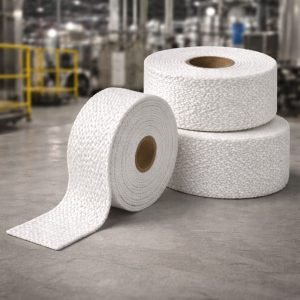
Ceramic Fiber Tape
Ceramic Tape is a woven fabric made from high quality ceramic fiber woven yarn.It…
Insulation Products
Ceramic Fiber Tape
Ceramic Tape is a woven fabric made from high quality ceramic fiber woven yarn.It…
 Insulation Products
Ceramic Paper
Ceramic fiber paper is manufactured from high-grade ceramic fiber with low slag ball content…
Insulation Products
Ceramic Paper
Ceramic fiber paper is manufactured from high-grade ceramic fiber with low slag ball content…
 Heat Proof Cloth
Vermiculite Coated Silica Cloth
Vermiculite is a natural mineral which provides a natural inorganic finish to silica cloth.This…
Heat Proof Cloth
Vermiculite Coated Silica Cloth
Vermiculite is a natural mineral which provides a natural inorganic finish to silica cloth.This…
 Fiberglass Products
Glass Cloth
It is made of continuous C glass or E glass filament texturized yarns.They demonstrate…
Fiberglass Products
Glass Cloth
It is made of continuous C glass or E glass filament texturized yarns.They demonstrate…
 Gland Packings
Graphite Gland Packing
Product Description This type of gland packing is made from graphite-PTFE compound with lubricant…
Gland Packings
Graphite Gland Packing
Product Description This type of gland packing is made from graphite-PTFE compound with lubricant…
Engineering Resources
Work it out before you pick up the phone
Calculators, reference charts and technical guides for Steel Plants & Foundries.
Technical Articles & Installation Guides
Industry FAQ
Questions Steel Plants & Foundries engineers actually ask
Is 1260°C ceramic fibre good for 1260°C service?
No. 1260°C is the classification temperature — a fibre test rating. Realistic continuous service for that grade is around 1100°C. Specifying a furnace lining from the headline number is how furnaces end up under-insulated.
Why is ceramic fibre better than brick for a cycled furnace?
Low heat storage. Brick absorbs an enormous amount of energy just heating itself up on every cycle. Fibre stores very little, so the furnace reaches working temperature faster and burns less fuel per cycle. On a furnace that cycles with production, this is the dominant saving.
Can I use glass cloth for molten metal splash?
No — and this is an important distinction. Temperature rating and splash rating are different things. For direct molten metal contact you need vermiculite-coated silica cloth, which is specifically rated for splash. Plain fibreglass will not protect against molten metal.
Blanket or board for the hot face?
Blanket is flexible, cheaper, and fine for back-up insulation and most hot faces. Board is rigid and resists gas erosion and mechanical abuse far better — use it for the hot face in high-velocity gas zones. They are frequently used together.
How do I know if my furnace lining is failing?
It degrades invisibly. Blanket that still looks intact can have lost density from gas erosion, vibration and cycling, and it will be costing you fuel long before it obviously breaks. Inspect at every shutdown rather than waiting for visible failure.
Is ceramic fibre safe to handle?
It requires precautions. Cutting or disturbing it releases airborne fibre, and after service ceramic fibre can contain crystalline silica — which makes removing an old lining the highest-exposure task. Use gloves, eye protection and a proper dust mask.
Why Al-Hamd Traders
For Steel Plants & Foundries, specifically
We have done furnace work
Ceramic fibre insulation supplied to Mughal Steel for high-temperature expansion joints — case study below.
Specified against real temperature
We ask for your continuous operating temperature, not the peak and not the classification figure.
We separate heat from splash
A material rated for 1000°C is not necessarily rated for molten metal contact. We will not conflate the two.
Shutdown-aware supply
Furnace work happens in a fixed shutdown window. We schedule material against yours.
Tell us the problem. We’ll confirm the material.
Send us your operating conditions — temperature, pressure, media — or a drawing, and we will tell you what actually works. Including when the cheaper option is the better one.